


Introduction
Artificial Intelligence is transforming almost every industry, from healthcare and finance to marketing, automation, software development, and business analytics. Companies are no longer looking only for professionals who understand AI concepts; they need people who can build, deploy, and manage real-world AI solutions.
This is why AI Engineering Courses are becoming increasingly popular among students, developers, data analysts, and working professionals who want to build future-ready skills.
Unlike traditional programming courses, AI engineering focuses on the complete AI development lifecycle:
- Collecting and preparing data
- Building machine learning models
- Training deep learning systems
- Deploying AI applications
- Monitoring model performance
The demand for practical AI skills continues to grow as organisations adopt Generative AI, automation systems, and intelligent applications.
In this detailed review, we analyse one practical Udemy course:
Machine Learning, Deep Learning & Model Deployment
This course is designed for learners who want to understand machine learning algorithms, deep learning concepts, and how AI models move from development into production environments.
👉 Check Latest Price & Course Details on Udemy
Table of Contents
How We Selected
Choosing the right AI course can be difficult because thousands of online programs are available.
For evaluating the best AI Engineering Courses, we considered important factors:
1. Practical Learning Approach
A good AI course should not focus only on theory.
We checked:
✅ Real-world projects
✅ Coding practice
✅ Machine learning implementation
✅ Deployment knowledge
The selected Udemy course focuses on practical machine learning workflows, including building and deploying models. Udemy
2. Industry-Relevant Skills
Modern AI engineers require knowledge of:
- Python programming
- Machine Learning
- Deep Learning
- Neural Networks
- Model Deployment
- MLOps concepts
Courses that teach these skills provide better career value.
3. Beginner-Friendly Structure
The course should help learners progress from fundamentals to advanced topics without unnecessary complexity.
4. Career Value
We considered whether the course helps learners build:
- Portfolio projects
- Job-ready skills
- Practical AI applications
👉 Check Latest Price & Course Details on Udemy
AI Engineering Courses Comparison Table

| Course | Best For | Main Skills | Level |
|---|---|---|---|
| Machine Learning, Deep Learning & Model Deployment (Udemy) | Practical AI development | ML, Deep Learning, Deployment | Beginner-Intermediate |
| DeepLearning.AI Machine Learning Specialization | AI fundamentals | ML Algorithms | Beginner |
| IBM AI Engineering Professional Certificate | Complete AI pathway | Python, ML, Deep Learning | Beginner-Intermediate |
| Hugging Face LLM Course | Generative AI developers | Transformers, LLMs | Intermediate |
| fast.ai Deep Learning Course | Developers | Deep Learning Projects | Intermediate |
Detailed Analysis
Course Overview: Machine Learning, Deep Learning & Model Deployment
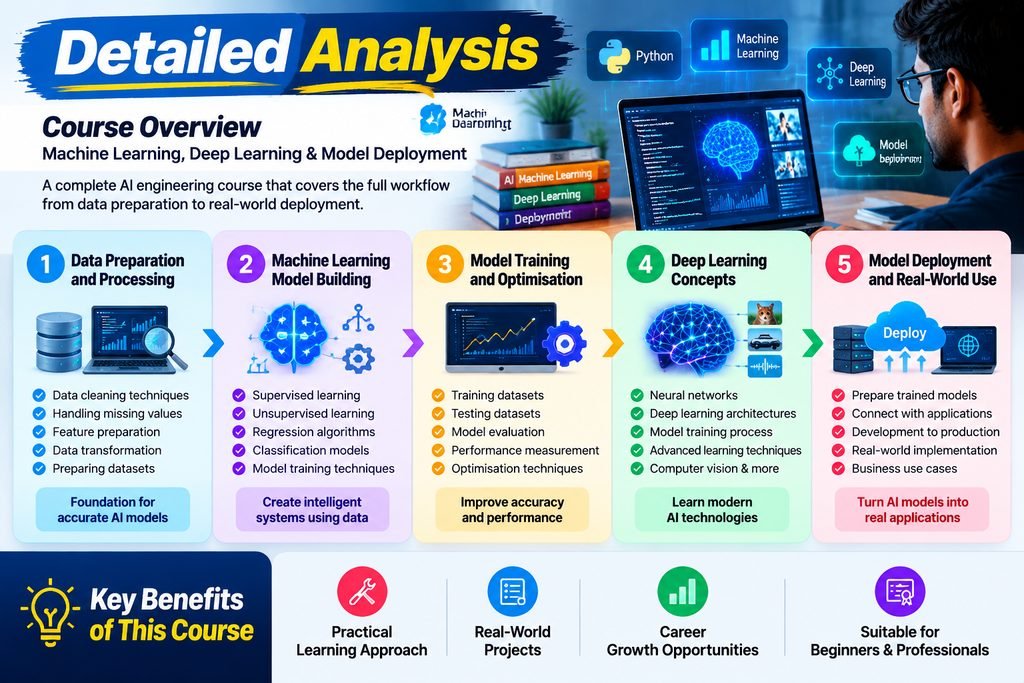
The Machine Learning, Deep Learning & Model Deployment Udemy course is designed for learners who want to understand the complete process of creating, improving, and deploying modern artificial intelligence solutions.
In today’s rapidly growing AI industry, understanding only machine learning algorithms is not enough. Companies are looking for professionals who can transform data into intelligent systems and deploy those systems into real-world applications.
Among the available AI Engineering Courses, this Udemy program stands out because it focuses on the practical AI development lifecycle — starting from data preparation and continuing through model development, evaluation, optimisation, and deployment.
Instead of concentrating only on mathematical theories, this course follows a practical approach that helps learners understand how AI projects are developed in professional environments.
The complete AI workflow covered in this course includes:
Data Collection → Data Processing → Model Development → Training → Evaluation → Optimisation → Deployment
This approach makes it valuable for beginners, data professionals, developers, and anyone planning to build a career in artificial intelligence.
👉 Check Latest Price & Course Details on Udemy
1. Data Preparation and Processing
The Foundation of Every Successful AI Model
Data is the most important component of any artificial intelligence system. A machine learning model can only perform effectively when the data used for training is accurate, clean, and properly structured.
The course introduces learners to essential data preparation techniques required before building AI models.
Key concepts include:
✅ Data cleaning methods
✅ Handling missing and inconsistent data
✅ Feature selection and preparation
✅ Data transformation techniques
✅ Preparing datasets for machine learning algorithms
Understanding data preparation helps learners improve model accuracy and avoid common mistakes during AI development.
For aspiring AI engineers, strong data handling skills are essential because real-world datasets are often complex, incomplete, and require significant preparation before they can be used effectively.
2. Machine Learning Model Building
Creating Intelligent Systems Using Data
Machine learning is the core foundation of artificial intelligence. It enables computers to identify patterns, learn from previous information, and make predictions without being explicitly programmed.
This course introduces learners to important machine learning concepts, including:
Supervised Learning
Learners understand how models use labelled datasets to make predictions.
Examples:
- Customer prediction systems
- Sales forecasting
- Risk analysis
Unsupervised Learning
The course explains how AI systems identify hidden patterns within datasets.
Examples:
- Customer segmentation
- Pattern recognition
- Data grouping
Machine Learning Algorithms
Learners explore different approaches for solving business problems using:
- Regression algorithms
- Classification models
- Training techniques
- Prediction methods
This practical understanding helps learners select suitable machine learning methods depending on project requirements.
3. Model Training and Optimisation
Improving AI Accuracy and Performance
Developing an AI model is not just about selecting an algorithm. A successful AI system requires proper training, testing, and continuous improvement.
The course explains important model optimisation concepts such as:
✅ Training datasets
✅ Testing datasets
✅ Model evaluation methods
✅ Performance measurement
✅ Improving prediction accuracy
✅ Optimisation techniques
Learners understand how to analyse model performance and make improvements when results do not meet expectations.
These skills are highly valuable because professional AI engineers spend significant time improving and maintaining AI models after initial development.
4. Deep Learning Concepts
Understanding Advanced AI Technologies
Deep learning is responsible for many modern AI breakthroughs, including:
- Image recognition
- Voice assistants
- Recommendation systems
- Autonomous technologies
- Generative AI applications
The course introduces learners to important deep learning concepts, including:
Neural Networks
Learners understand how artificial neural networks simulate human brain-like learning processes.
Deep Learning Architectures
The course provides knowledge about how advanced AI models are structured and trained.
AI Model Training Process
Learners gain an understanding of:
- How deep learning models learn patterns
- How training improves results
- How AI systems handle complex problems
These concepts create a strong foundation for learners who want to continue into advanced fields such as Generative AI, Large Language Models (LLMs), and AI automation.
5. Model Deployment and Real-World Implementation
Turning AI Models Into Practical Applications
One of the biggest differences between a beginner and a professional AI engineer is the ability to deploy AI models successfully.
Creating a machine learning model is only the first stage. In real business environments, AI solutions need to be integrated into applications where users can access predictions and insights.
This course introduces learners to the importance of model deployment, including:
✅ Preparing trained models for real-world use
✅ Connecting AI models with applications
✅ Understanding the transition from development to production
✅ Applying machine learning solutions in practical environments
Deployment knowledge is becoming increasingly important because companies need AI professionals who can build complete solutions, not just experimental models.
6. Practical Learning Approach and Career Value
Building Skills Beyond Theory
A major advantage of this course is its practical learning approach.
Instead of learning isolated concepts, students understand how different AI components work together:
Data → Machine Learning → Deep Learning → Model Evaluation → Deployment
This complete workflow helps learners develop skills required for modern AI roles.
After completing this course, learners can continue exploring advanced areas such as:
- Generative AI development
- Large Language Models (LLMs)
- AI Agents
- MLOps
- AI-powered automation systems
For anyone searching for AI Engineering Courses, this Udemy program provides a practical foundation to understand how artificial intelligence systems are designed and implemented in real-world scenarios.
👉 Check Latest Price & Course Details on Udemy
Machine Learning Fundamentals

Machine learning is the foundation of modern artificial intelligence and one of the most important topics covered in professional AI Engineering Courses.
Before building advanced AI applications, learners need to understand how machines analyse data, identify patterns, and make intelligent decisions.
This Udemy course introduces the essential machine learning concepts required for anyone starting their journey in AI engineering.
The course helps learners understand:
- Supervised learning techniques
- Unsupervised learning methods
- Regression models
- Classification algorithms
- Model evaluation techniques
- Prediction-based machine learning systems
These concepts form the foundation for advanced AI technologies and help learners understand how real-world AI solutions are developed.
For students exploring AI Engineering Courses, machine learning knowledge is one of the most important skills because almost every AI application depends on effective data learning and prediction capabilities.
A strong understanding of machine learning allows learners to move confidently into advanced areas such as deep learning, Generative AI, computer vision, and AI automation.
Deep Learning Concepts
Deep learning is one of the most advanced and rapidly growing areas covered in modern AI Engineering Courses.
Deep learning technologies power many AI applications that people use every day, including:
- Image recognition systems
- Voice assistants
- Recommendation engines
- Autonomous technologies
- Generative AI applications
The course introduces learners to important deep learning concepts, including:
- Neural networks
- Deep learning architectures
- Training processes
- AI model optimisation
- Advanced learning techniques
Understanding deep learning is essential for anyone interested in becoming an AI engineer because many modern intelligent systems rely on deep neural networks.
Among different AI Engineering Courses, programs that include deep learning provide better career value because they prepare learners for advanced AI development roles.
For anyone searching for practical AI Engineering Courses, learning deep learning concepts creates a strong foundation for working with modern AI technologies.
👉 Check Latest Price & Course Details on Udemy
Model Deployment and Real-World AI Applications

One major difference between beginners and professional AI engineers is the ability to deploy AI models into real-world applications.
Many learners complete machine learning projects but struggle with the final stage — making those models available for practical use.
Professional AI Engineering Courses focus not only on creating models but also on deploying, managing, and improving AI solutions.
Building a machine learning model is only one part of complete AI engineering.
A successful AI engineer should understand:
- How to save trained machine learning models
- How to integrate AI models into applications
- How to create prediction systems
- How to move AI projects from development to production environments
This course introduces model deployment concepts and helps learners understand the complete journey of AI development.
For learners comparing AI Engineering Courses, deployment knowledge is a major advantage because companies increasingly need professionals who can build complete AI solutions.
Programming Skills Required for AI Engineering
Programming knowledge is an essential requirement for anyone choosing AI Engineering Courses.
Python is currently one of the most popular programming languages used in artificial intelligence and machine learning development.
The course helps learners understand the importance of programming skills, including:
- Python fundamentals
- Data handling techniques
- AI-related libraries
- Machine learning frameworks
- Coding practices for AI projects
A strong Python foundation helps learners build machine learning models, analyse datasets, and create AI-powered applications.
For beginners selecting AI Engineering Courses, choosing a program that includes practical Python usage can make the learning journey easier and more effective.
Python knowledge also helps learners continue into advanced areas such as deep learning frameworks, Generative AI development, and automation systems.
Project-Based Learning Benefits
Practical projects are one of the most important factors when selecting AI Engineering Courses.
Employers usually value candidates who can demonstrate real-world problem-solving skills rather than only theoretical knowledge.
This course encourages learners to apply AI concepts through practical implementation.
After completing the course, learners can work towards building:
✅ Machine learning prediction models
✅ AI automation tools
✅ Data-driven intelligent applications
✅ Real-world machine learning solutions
✅ AI-powered business applications
Building projects helps learners create a stronger portfolio and improves their confidence when applying for AI-related roles.
Among available AI Engineering Courses, project-based learning provides better career benefits because it helps bridge the gap between learning concepts and applying them in professional environments.
A strong project portfolio can support opportunities such as:
- AI Engineer
- Machine Learning Engineer
- Data Scientist
- AI Application Developer
- Automation Specialist
Why These Skills Matter in AI Careers
The combination of machine learning, deep learning, programming, deployment, and project experience creates a complete foundation for anyone interested in artificial intelligence careers.
The best AI Engineering Courses are those that teach learners how different AI components work together:
Python → Data → Machine Learning → Deep Learning → Model Deployment → Real-World AI Applications
This complete learning path helps beginners and professionals develop practical skills needed for the growing AI industry.
Pros & Cons

Pros
✅ Practical machine learning approach
✅ Covers deep learning concepts
✅ Includes model deployment knowledge
✅ Suitable for beginners entering AI
✅ Helps build career-focused skills
✅ Self-paced learning through Udemy
Cons
❌ Requires basic Python knowledge
❌ Advanced AI topics may require additional learning
❌ More projects may be needed for portfolio building
❌ Not designed as a complete AI research program
Who Should Buy?
1. Beginners Interested in AI Careers
If you want to enter artificial intelligence, this course provides a structured starting point.
2. Data Analysts Moving Towards AI
Professionals with Excel, SQL, Power BI, and analytics backgrounds can use this knowledge to move into AI-powered analytics roles.
3. Python Developers
Developers who want to add AI capabilities to applications can benefit.
4. Students
Students looking for future technology skills can build a foundation.
Alternatives
1. DeepLearning.AI Courses
Best for learners who want structured AI education from industry experts.
Suitable for:
- Machine learning beginners
- AI professionals
- Generative AI learners
2. IBM AI Engineering Professional Certificate
Good option for learners who want a complete certification pathway.
Topics include:
- Machine learning
- Deep learning
- AI applications
3. Hugging Face LLM Course
Recommended for advanced learners interested in:
- Large Language Models
- Transformers
- Generative AI
4. fast.ai Deep Learning Course
Best for developers who prefer practical coding-based learning.
👉 Check Latest Price & Course Details on Udemy
Top Reasons to Buy This AI Engineering Course
1. Learn Complete AI Workflow
The biggest advantage is learning the journey from data to deployed AI model.
2. Practical Career Skills
The course focuses on useful skills rather than only theoretical concepts.
3. Understand Model Deployment
Deployment knowledge helps differentiate AI engineers from basic machine learning learners.
4. Build Strong AI Foundation
It creates a foundation for advanced topics like:
- Generative AI
- LLM applications
- AI automation
5. Flexible Self-Paced Learning
Udemy allows learners to study according to their own schedule.
Recommended For
This course is recommended for:
⭐ Beginners entering AI
⭐ Python learners
⭐ Data analysts
⭐ Software developers
⭐ Students
⭐ Professionals upgrading their technology skills
Frequently Asked Questions (FAQ)
What are AI Engineering Courses?
AI Engineering Courses teach learners how to design, develop, deploy, and maintain artificial intelligence systems.
Is AI engineering difficult for beginners?
Beginners can learn AI engineering by starting with Python, mathematics basics, machine learning, and practical projects.
Do I need programming knowledge for AI engineering?
Basic Python knowledge is highly recommended.
Is this Udemy AI course worth buying?
Yes, it is useful for learners who want practical knowledge of machine learning, deep learning, and deployment concepts.
Can AI engineering help my career?
Yes. AI skills are becoming valuable across software development, analytics, automation, and business applications. The Financial Express
Final Verdict
Among the growing number of AI Engineering Courses available online, the Machine Learning, Deep Learning & Model Deployment Udemy course is a practical choice for learners who want to understand how modern artificial intelligence systems are created, trained, and deployed.
The biggest advantage of this course is its practical approach. Many AI Engineering Courses focus mainly on theoretical concepts, but this program helps learners understand the complete AI workflow — from preparing data and building machine learning models to optimising performance and deploying AI solutions in real-world applications.
For beginners entering the artificial intelligence field, this course provides a strong foundation in:
✅ Machine Learning fundamentals
✅ Deep Learning concepts
✅ AI model development
✅ Model evaluation techniques
✅ Real-world deployment practices
When comparing different AI Engineering Courses, this Udemy program offers good value for learners who want flexible, self-paced training with practical knowledge. It is especially useful for students, Python developers, data analysts, and working professionals who want to upgrade their skills and move towards AI-related careers.
However, completing one course alone is not enough to become a professional AI engineer. Learners should continue expanding their knowledge by exploring advanced topics such as:
- Generative AI
- Large Language Models (LLMs)
- AI Agents
- MLOps
- AI automation systems
The best AI Engineering Courses should help learners build practical skills, create projects, and develop problem-solving abilities. This course provides the right foundation, but continuous practice and project development are important for long-term success.
Overall, among beginner-friendly AI Engineering Courses, the Machine Learning, Deep Learning & Model Deployment course is a valuable investment for anyone who wants to start their AI engineering journey and understand how artificial intelligence solutions are built from concept to deployment.
Overall Rating: ⭐ 8.5/10
👉 Check Latest Price & Course Details on Udemy
Recommended for learners who want practical AI skills, career growth opportunities, and a strong foundation before moving into advanced artificial intelligence technologies.
2 thoughts on “AI Engineering Courses: Learn Machine Learning, Deep Learning & AI Deployment in 2026”