



Introduction
Smart home technology is rapidly changing the way we live. From voice-controlled lights and automated security systems to intelligent appliances, IoT-based solutions are becoming more popular among homeowners, students, and technology enthusiasts.
Learning how these systems work requires practical knowledge of sensors, microcontrollers, programming, and automation platforms. A good Smart Home Automation Course can help beginners understand how connected devices communicate and how real-world automation projects are created.
Among the available online courses, Build a Smart Home with ESP32 & Google Home | 2026 on Udemy focuses on practical IoT learning by teaching ESP32 programming, relay control, and Google Home integration.
In this detailed review, we will analyze the course features, learning outcomes, advantages, limitations, alternatives, and whether it is worth buying.
👉 Check Latest Price & Course Details on Udemy
Table of Contents
How We Selected This Course
While selecting the best Smart Home Automation Course, we considered several important factors:
1. Practical Project-Based Learning
Instead of only teaching theory, the course focuses on building an actual smart home automation system using ESP32.
2. Beginner-Friendly Approach
The course is designed for students, hobbyists, and beginners who want to enter IoT and embedded systems.
3. ESP32 Technology
ESP32 is one of the most popular development boards for IoT projects because it provides wireless connectivity and powerful features at an affordable cost.
4. Google Home Integration
Voice-controlled automation is becoming an important part of modern smart homes. Learning Google Home integration provides practical industry exposure.
5. Course Resources
The course includes:
- On-demand video lessons
- Coding exercises
- Assignments
- Downloadable resources
- Lifetime access

Course Comparison Table
| Feature | Details |
|---|---|
| Course Name | Build a Smart Home with ESP32 & Google Home |
| Platform | Udemy |
| Category | IT & Software → Hardware → ESP32 |
| Skill Level | Beginner to Intermediate |
| Duration | Around 3 hours |
| Lectures | 59 lectures |
| Sections | 10 sections |
| Technology Covered | ESP32, IoT, Google Home |
| Learning Style | Practical Project-Based |
| Language | English |
| Suitable For | Students, hobbyists, IoT beginners |
Detailed Analysis
What Will You Learn in This Smart Home Automation Course?
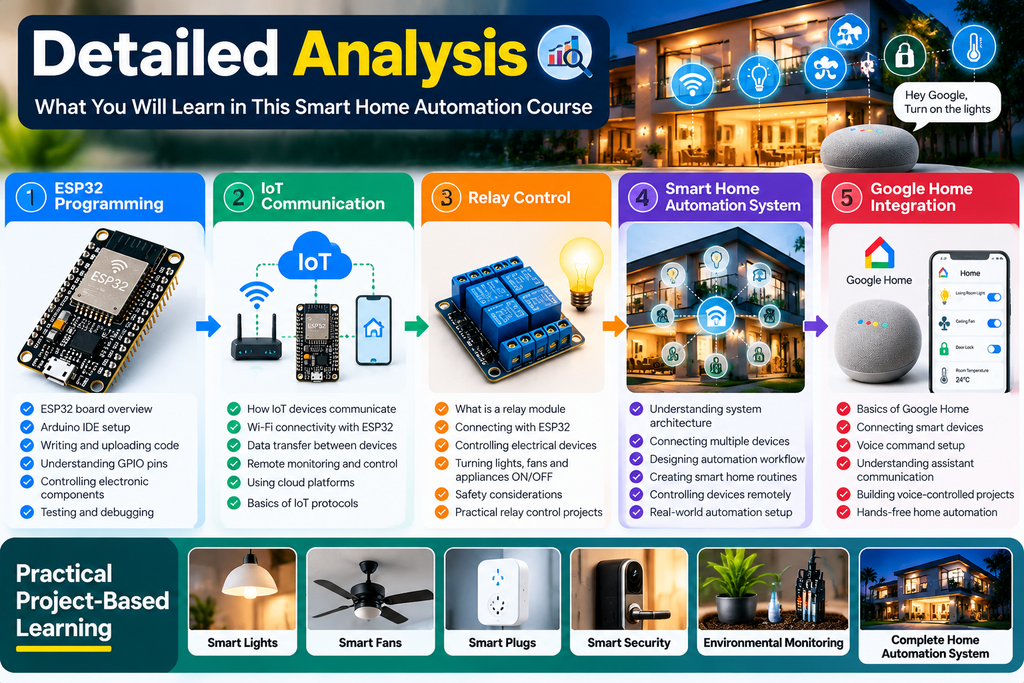
This Smart Home Automation Course is designed to help beginners and technology enthusiasts understand how modern IoT-based smart home systems are designed, developed, and controlled. The course focuses on practical learning by combining ESP32 programming, hardware components, IoT communication, relay control, and Google Home integration.
Instead of only learning theory, students get a clear understanding of how different smart home components work together to create an automated environment where devices can be monitored and controlled remotely.
1. ESP32 Programming: Building the Foundation of Smart Devices
The course introduces learners to the ESP32 development board, one of the most popular microcontrollers used in IoT and smart home projects.
ESP32 is widely used because it comes with built-in:
- Wi-Fi connectivity
- Bluetooth support
- Multiple GPIO pins
- Low power consumption
- Powerful processing capability
Through this section, learners understand how to program ESP32 and use it as the brain of a smart home system.
You will learn:
- ESP32 board architecture and important components
- Setting up the programming environment
- Installing and configuring Arduino IDE
- Writing basic ESP32 programs
- Understanding GPIO pins and their applications
- Controlling connected electronic components
- Uploading and testing programs on the ESP32 board
This knowledge helps beginners understand how smart devices such as smart lights, smart switches, and automated appliances are created.
2. IoT Communication: Connecting Devices to the Internet
A smart home system becomes powerful when devices can communicate with each other and with users through the internet.
This section explains the fundamentals of IoT (Internet of Things) communication and how connected devices exchange information.
You will learn:
- How IoT devices communicate
- The role of Wi-Fi connectivity in smart homes
- How ESP32 connects with online platforms
- Data transfer between devices
- Basics of device monitoring and remote control
- How sensors and controllers communicate
For example, when you switch on a smart light using a mobile app or voice command, multiple IoT communication processes happen in the background.
Understanding these concepts helps learners build practical automation projects instead of only using ready-made smart devices.
3. Relay Control: Managing Electrical Appliances
Relay control is one of the most important concepts in home automation because it allows low-voltage controllers like ESP32 to operate high-voltage electrical devices.
The course explains how relay modules work and how they are used in smart automation projects.
You will learn:
- What is a relay module
- How relays control electrical circuits
- Connecting relay modules with ESP32
- Turning devices ON/OFF through programming
- Controlling lights, fans, and other appliances
- Understanding safety considerations while working with electrical components
With relay automation, learners can create projects such as:
- Smart lights
- Automated fans
- Remote-controlled appliances
- Voice-controlled home systems
This practical knowledge is essential for anyone interested in DIY smart home projects.
4. Creating a Smart Home Automation System
The course explains how individual components combine together to create a complete smart home ecosystem.
A smart home system usually includes:
- Microcontroller (ESP32)
- Sensors
- Relay modules
- Internet connectivity
- Mobile applications
- Voice assistants like Google Home
You will understand:
- How smart home architecture works
- Designing an automation workflow
- Connecting multiple devices together
- Controlling appliances remotely
- Creating automated routines
For example:
A user can say:
“Hey Google, turn on the bedroom light”
The command travels through Google Home, communicates with the IoT platform, reaches ESP32, and activates the relay connected to the light.
This section helps learners understand the complete process behind voice-controlled automation.
5. Google Home Integration: Voice-Controlled Automation
One of the most interesting parts of modern smart homes is voice control.
This course introduces how ESP32-based projects can work with Google Home to create hands-free automation.
You will learn:
- Basics of Google Home integration
- Connecting smart devices with voice assistants
- Creating voice-based commands
- Understanding smart assistant communication
- Building practical voice-controlled projects
After learning this concept, students can explore projects like:
- Voice-controlled lights
- Smart fan controllers
- Automated home appliances
- Custom IoT devices
This knowledge is valuable because voice assistants are becoming an important part of future smart homes.
6. Hardware Integration: Combining Electronics and Programming
Smart home automation requires both hardware and software knowledge.
This section focuses on how different electronic components work together to create a complete project.
You will learn:
- Connecting ESP32 with external components
- Understanding sensors and modules
- Basic circuit connections
- Testing hardware components
- Troubleshooting common issues
- Integrating software commands with physical devices
This practical approach helps learners move from basic programming concepts to real-world IoT applications.
7. Practical Project-Based Learning
The biggest advantage of this Smart Home Automation Course is its project-focused approach.
Instead of learning only concepts, students get exposure to building automation systems step by step.
Projects help learners understand:
- Real-world applications of IoT
- Problem-solving techniques
- Hardware troubleshooting
- Programming logic
- Complete automation workflow
By completing projects, learners can develop confidence to create their own smart home solutions.
Overall Learning Outcome
After completing this Smart Home Automation Course, learners will have a strong understanding of:
✅ ESP32 programming fundamentals
✅ IoT communication concepts
✅ Smart device control systems
✅ Relay-based automation
✅ Google Home integration
✅ Hardware and software interaction
✅ Building basic smart home projects
This course is a good starting point for beginners who want to enter the world of IoT, smart home technology, and automation projects.
👉 Check Latest Price & Course Details on Udemy
Why ESP32 is Important for Smart Home Projects?
ESP32 has become popular among IoT developers because it offers:
- Wi-Fi connectivity
- Bluetooth support
- Low-cost development
- Multiple GPIO pins
- Support for sensors and modules
For beginners entering IoT, learning ESP32 provides a strong foundation for creating automation projects.
Pros & Cons
Pros
✅ Practical smart home project approach
✅ Beginner-friendly explanation
✅ Covers ESP32 and Google Home integration
✅ Includes coding exercises
✅ Suitable for IoT beginners
✅ Lifetime access through Udemy
Cons
❌ English language only
❌ Requires basic electronics understanding
❌ Hardware components may need separate purchase
❌ Not focused on advanced industrial automation
Who Should Buy This Course?
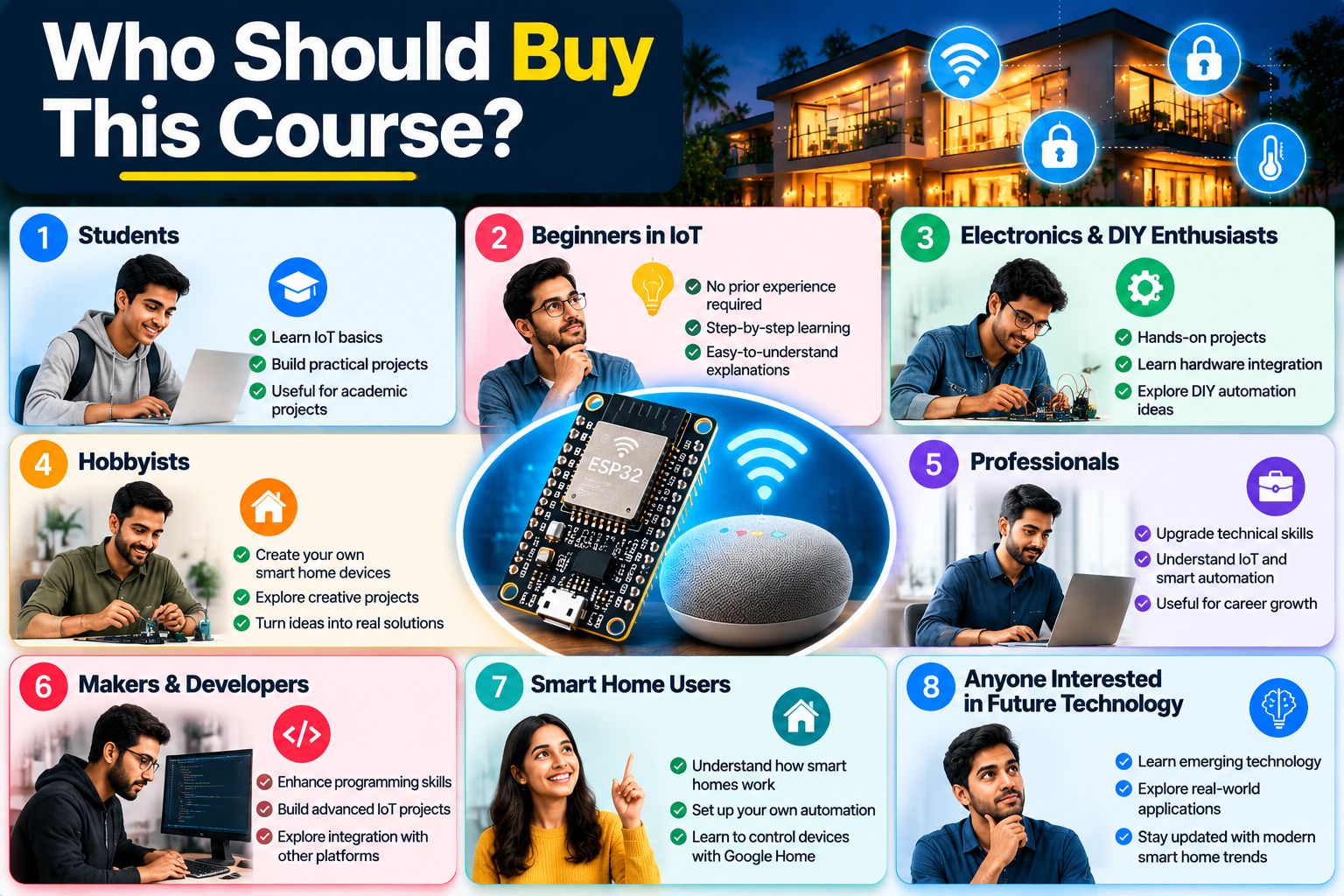
This Smart Home Automation Course is recommended for:
1. Electronics Students
Students who want practical experience beyond classroom theory.
2. IoT Beginners
Anyone interested in starting a career in IoT development.
3. DIY Smart Home Enthusiasts
People who want to create their own automated home projects.
4. Embedded System Learners
Those interested in ESP32 and microcontroller programming.
5. Technology Content Creators
Creators who want practical knowledge about smart home technology.
Alternatives to This Course
1. ESP32 for IoT – Build Real World Projects
Best for learners who want deeper IoT concepts including MQTT, HTTP, sensors, and automation projects.
2. Ultimate Guide to Smart Home using ESP32
Good option for learners who want ESP32, Arduino, Blynk Cloud, and app-based automation projects.
3. Home Automation Step-by-Step Guide
Suitable for beginners who want to understand general smart home concepts.
Top Reasons to Buy This Smart Home Automation Course
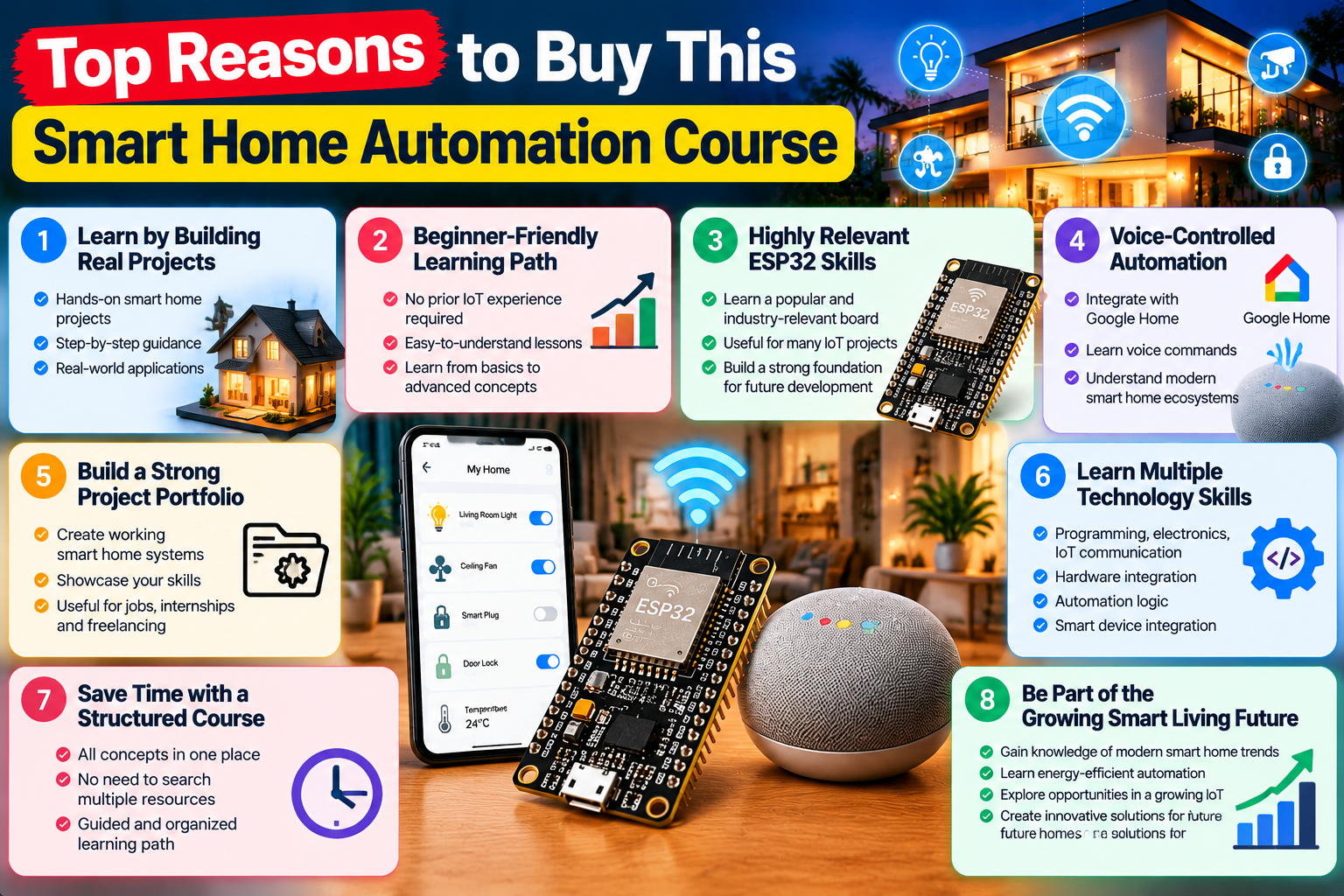
1. Learn by Building Real-World Smart Home Projects
The biggest advantage of this Smart Home Automation Course is its practical, project-based learning approach. Instead of only studying IoT concepts and programming theory, you learn how different components work together in a real automation environment.
Throughout the course, you get exposure to the complete development process, including:
- Understanding project requirements
- Selecting suitable hardware components
- Programming the controller
- Connecting electronic modules
- Testing automation workflows
- Troubleshooting common issues
This practical approach helps learners understand how professional IoT solutions are developed. By working on real projects, you can gain confidence in designing your own smart home systems rather than depending only on ready-made products.
2. Beginner-Friendly Entry Point into IoT and Automation
Starting with IoT can feel complicated because it involves multiple technologies such as electronics, programming, networking, and hardware integration.
This course provides a structured learning path that helps beginners understand these concepts step by step.
You don’t need to be an expert in electronics or advanced programming before starting. The course introduces important concepts gradually, allowing learners to build their knowledge from the basics.
It is useful for:
- Students interested in electronics and technology
- Beginners exploring IoT careers
- Hobbyists who want to create DIY projects
- Professionals looking to understand smart automation trends
The step-by-step approach makes it easier to move from basic concepts to practical applications.
3. ESP32 Skills Are Highly Valuable for Future IoT Projects
ESP32 has become one of the most popular development boards in the IoT industry because it offers powerful features at an affordable cost.
Learning ESP32 gives you a strong foundation for creating different types of connected devices beyond smart home applications.
The skills you learn can be applied to projects such as:
- Smart security systems
- Environmental monitoring devices
- Automated irrigation systems
- Wearable technology projects
- Industrial monitoring solutions
- Energy management systems
Since many IoT products use similar concepts, understanding ESP32 programming can help you explore a wide range of technology projects.
4. Understand Modern Voice-Controlled Smart Home Technology
Voice assistants have changed how people interact with technology. Smart speakers and voice platforms allow users to control devices naturally without manually operating switches or applications.
This course helps you understand the technology behind voice-controlled automation by introducing Google Home integration.
You will gain knowledge about:
- How voice commands interact with smart devices
- The role of cloud-based smart assistants
- Communication between different smart home components
- Creating convenient automation experiences
Understanding these concepts helps you stay updated with modern smart home trends, where voice control, automation routines, and connected ecosystems are becoming increasingly common.
5. Build Portfolio Projects to Showcase Your Technical Skills
One of the biggest challenges for beginners entering IoT is proving their practical ability.
Completing projects from this course can help you create examples of your technical knowledge that you can showcase.
Your projects can become valuable for:
- College demonstrations
- Internship applications
- Job interviews
- Freelance opportunities
- Personal technology portfolios
A working smart home automation project demonstrates that you understand more than just theory — you can design, build, program, and test a complete technology solution.
6. Understand the Future of Smart Living Technology
Smart homes are becoming an important part of modern technology, with increasing adoption of:
- Connected appliances
- Automated lighting systems
- Smart security devices
- Energy-saving solutions
- AI-powered home assistants
Learning smart home automation gives you knowledge about a growing technology field.
This course helps you understand the foundation behind many devices that will become common in future homes and buildings.
7. Develop Multiple Technology Skills in One Course
Smart home automation requires knowledge from different technology areas. This course helps you combine multiple skills instead of focusing on only one topic.
You get exposure to:
- Microcontroller programming
- Electronics fundamentals
- IoT communication
- Hardware connections
- Automation logic
- Smart device integration
Learning these connected skills gives you a broader understanding of how modern technology products are created.
8. Save Time Compared to Learning Everything Separately
Learning IoT independently often requires searching through multiple resources for ESP32 programming, electronics, communication protocols, and automation projects.
This course organizes the learning process into a single structured path.
Instead of spending months collecting scattered information, learners can follow a guided approach and focus on practical skill development.
9. Suitable for DIY Creators and Technology Enthusiasts
If you enjoy experimenting with technology, this course provides ideas and knowledge to create your own automation projects.
You can use the concepts learned here to customize solutions based on your needs, such as:
- Automated room lighting
- Smart appliance control
- Customized IoT devices
- Home monitoring solutions
It is a useful learning experience for anyone interested in creating technology rather than only consuming it.
Final Summary
The Smart Home Automation Course is valuable because it combines IoT concepts, ESP32 programming, hardware integration, and practical automation projects in one learning path.
Whether you are a beginner exploring IoT, a student building technical skills, or a technology enthusiast interested in smart homes, this course provides practical knowledge that can help you understand and create modern connected devices.
Frequently Asked Questions (FAQ)
Is this Smart Home Automation Course suitable for beginners?
Yes. The course is designed for beginners, students, hobbyists, and IoT enthusiasts.
Do I need previous programming knowledge?
Basic programming knowledge is helpful, but beginners can follow the lessons.
Do I need ESP32 hardware?
For practical implementation, you may need ESP32 boards and related components separately.
Can I build a real smart home project after completing this course?
Yes. The course focuses on building a functional IoT-based automation project.
Is Google Home required?
Google Home hardware may be useful for testing voice automation, but the course explains the concepts and implementation.
Final Verdict
The Build a Smart Home with ESP32 & Google Home | 2026 course is a good choice for beginners who want to enter IoT and smart home automation.
It provides a practical introduction to ESP32 programming, automation concepts, and voice-controlled smart devices.
If your goal is to understand how smart homes work and build your first IoT project, this Smart Home Automation Course is worth considering.
Recommended For
⭐ IoT beginners
⭐ Electronics students
⭐ Smart home enthusiasts
⭐ DIY technology lovers
⭐ Embedded system learners
Affiliate Recommendation
If you are interested in building smart devices, learning IoT fundamentals, and creating your own automation projects, this course can be a useful starting point.
One thought on “Best Smart Home Automation Course in 2026: Build IoT Projects with ESP32 & Google Home”