


Google eSIM: The Future of Digital Mobile Connectivity
The smartphone industry is rapidly moving towards smarter and more convenient technologies. One of the biggest changes in mobile connectivity is the replacement of traditional physical SIM cards with digital SIM technology.
Google eSIM is one of the important developments in this transformation. It allows users to activate mobile network services without inserting a physical SIM card into their smartphone.
Instead of using a removable plastic SIM, eSIM technology stores mobile network information digitally inside the device. Google has integrated eSIM support into its Pixel smartphone lineup and Android ecosystem, giving users a faster and more flexible way to connect with mobile networks.
As smartphones become more advanced with 5G connectivity, smart devices and global travel requirements, eSIM technology is expected to become a standard feature in future mobile devices.
In this complete guide, we will understand:
- What is Google eSIM?
- How Google eSIM works
- Technology behind eSIM
- Advantages and disadvantages
- How to buy and activate eSIM
- Future of digital SIM technology
Table of Contents
What is eSIM? Understanding the Technology Behind Digital SIM
Before understanding Google eSIM, it is important to know what an eSIM actually means and how it is different from the traditional SIM card that we have been using for many years.
An eSIM (Embedded Subscriber Identity Module) is a digital version of a physical SIM card. Instead of inserting a small plastic SIM into a smartphone, eSIM technology stores mobile network information electronically inside a built-in chip called eUICC (Embedded Universal Integrated Circuit Card).
The main purpose of eSIM technology is to remove the dependency on physical SIM cards and make mobile connectivity completely digital.
With an eSIM, users can:
- Activate mobile network services digitally
- Download a mobile operator profile remotely
- Switch between supported network providers
- Use multiple network profiles on compatible devices
The smartphone works with the mobile network in the same way as a normal SIM card, but the difference is that the SIM information is stored electronically instead of on a removable card.
How Does eSIM Technology Work?
A traditional SIM card stores subscriber information on a physical chip that users insert into their phones.
An eSIM works using a secure embedded chip inside the smartphone.
The process works like this:
1. Mobile Operator Creates an eSIM Profile
When a user requests an eSIM connection, the telecom provider creates a digital SIM profile containing:
- Subscriber information
- Network authentication details
- Security keys
- Mobile plan information
2. Profile is Downloaded Digitally
The telecom provider sends activation details, usually through:
- QR code
- Mobile application
- Activation link
The smartphone downloads the profile through a secure connection.
3. eSIM Chip Stores the Profile
The downloaded profile is stored inside the eUICC chip.
This chip securely manages the connection between the smartphone and the mobile network.
4. Smartphone Connects to Network
After activation, the smartphone communicates with the telecom network and provides authentication details.
The user can then access:
- Voice calls
- SMS
- Mobile data
- 4G/5G services
Although the technology is different, the final user experience is similar to using a traditional SIM card.
eSIM vs Normal SIM Card: What is the Difference?
The biggest difference between an eSIM and a normal SIM card is how the mobile network information is stored.
A normal SIM uses a physical removable card, while an eSIM uses software-based digital technology built into the device.
| Feature | eSIM | Normal Physical SIM |
|---|---|---|
| Full Form | Embedded Subscriber Identity Module | Subscriber Identity Module |
| Physical Card | No physical card required | Requires plastic SIM card |
| Installation | Digital activation | Insert manually |
| Replacement | Download new profile | Change physical card |
| Network Switching | Easier through software | Requires SIM replacement |
| Travel Usage | More convenient | Requires buying new SIM |
| Security | Stored inside secure chip | Can be removed physically |
| Device Design | Saves internal space | Requires SIM tray |
Advantages of eSIM Over Normal SIM
1. No Physical SIM Card Needed
The biggest benefit of eSIM is that users do not need a physical SIM card.
This eliminates problems like:
- Damaged SIM cards
- Lost SIM cards
- Broken SIM trays
2. Faster Activation
With eSIM, users can activate mobile services digitally without waiting for a physical SIM delivery.
3. Easy International Travel
Travellers can purchase international eSIM plans online and activate them without searching for local SIM cards after reaching another country.
4. Better Smartphone Design
Removing the physical SIM slot allows manufacturers to create:
- Slimmer devices
- Better water resistance
- More internal space
5. Multiple Network Profiles
Many eSIM-compatible smartphones can store multiple operator profiles.
Users can switch between:
- Personal number
- Business number
- Travel plan
depending on their requirements.
What is Google eSIM?
Google eSIM is Google’s implementation and support of eSIM technology on compatible Android devices, especially Google Pixel smartphones.
In simple words:
eSIM = The overall digital SIM technology
Google eSIM = eSIM technology used and supported by Google’s Pixel ecosystem
Google does not create a separate type of SIM. Instead, Google smartphones use standard eSIM technology and provide software support to make activation and management easier.
Google Pixel phones allow users to set up eSIM through device settings and connect with supported mobile operators.
Difference Between eSIM and Google eSIM
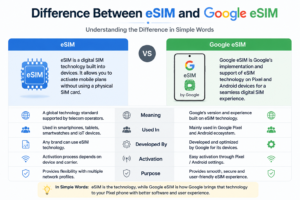
Many users think eSIM and Google eSIM are two different technologies, but they are actually related.
| Feature | eSIM | Google eSIM |
| Meaning | General digital SIM technology | Google’s implementation of eSIM support |
| Developed By | Industry standard supported by telecom companies | Google for Android and Pixel devices |
| Used In | Smartphones, tablets, watches, IoT devices | Mainly Google Pixel and Android ecosystem |
| Technology | Uses eUICC chip and digital SIM profiles | Uses standard eSIM technology with Google software support |
| Activation | Depends on device and carrier | Managed through Pixel/Android settings |
| Purpose | Replace physical SIM cards | Provide easy eSIM experience on Google devices |
Simple Example to Understand the Difference
Think of eSIM as a technology category, similar to “smartphone camera technology.”
Different companies use the same technology in different ways.
For example:
- eSIM is the technology.
- Google eSIM is Google’s implementation of that technology in Pixel phones.
- Apple eSIM is Apple’s implementation in iPhones.
- Samsung eSIM is Samsung’s implementation in Galaxy devices.
The basic technology remains the same, but the user experience depends on the device manufacturer and telecom operator.
Why Google eSIM is Important for the Future
Google eSIM represents the movement toward a completely digital mobile experience.
As more users adopt:
- 5G networks
- Smartwatches
- Connected devices
- IoT technology
digital SIM solutions will become increasingly important.
The future of mobile connectivity is moving away from physical cards toward secure, software-based solutions.
What is Google eSIM?
Google eSIM is a digital SIM technology that allows Google Pixel and compatible Android smartphones to connect to mobile networks without using a physical SIM card.
The word eSIM means Embedded Subscriber Identity Module. Unlike a traditional SIM card that can be removed and replaced manually, an eSIM is permanently embedded inside the smartphone hardware.
The eSIM uses a secure chip called eUICC (Embedded Universal Integrated Circuit Card), which stores mobile operator profiles digitally. This allows users to download their network information and activate cellular services electronically.
With Google eSIM, users can:
- Activate mobile plans digitally
- Switch between supported network providers
- Use multiple mobile profiles
- Avoid physical SIM replacement
Google eSIM vs Traditional Physical SIM
Traditional SIM cards have been used for decades. They store subscriber information on a removable chip that users insert into their smartphones.
Google eSIM changes this process by moving SIM functionality inside the device.
| Feature | Google eSIM | Physical SIM |
|---|---|---|
| Installation | Digital activation | Manual insertion |
| Hardware | Built-in eUICC chip | Removable plastic card |
| Network Switching | Easy through software | Requires SIM replacement |
| Travel Usage | More convenient | Requires buying local SIM |
| SIM Damage | No physical damage | Possible damage |
| Multiple Profiles | Supported | Limited |
The biggest difference is that eSIM separates mobile connectivity from physical hardware.
How Does Google eSIM Work?
The working process of Google eSIM is based on secure digital communication between the smartphone, mobile operator and eSIM management system.
When a user activates eSIM service, the smartphone downloads a digital SIM profile from the telecom provider.
The process happens in the following steps:
Step 1: eSIM Request
The user requests an eSIM connection from a telecom operator.
The operator creates a digital SIM profile linked with the user’s mobile account.
Step 2: Receiving Activation Details
The telecom provider provides:
- QR code
- Activation code
- Carrier app instructions
These details allow the smartphone to download the required network profile.
Step 3: Downloading eSIM Profile
The smartphone connects securely to the carrier’s eSIM platform and downloads the subscriber profile.
The profile is stored inside the eUICC chip.
Step 4: Network Authentication
After installation, the eSIM provides authentication information to the mobile network.
The network verifies the subscriber details and activates:
- Voice calling
- SMS services
- Mobile data
After successful activation, the smartphone works just like a device using a traditional SIM card.
Technology Behind Google eSIM
The technology behind Google eSIM involves multiple hardware and software components working together.
1. eUICC Secure Chip
The main component of eSIM technology is the eUICC chip.
It acts as a digital SIM card and securely stores mobile operator profiles.
Unlike physical SIM cards, eUICC can store multiple network profiles, allowing users to switch between different supported mobile plans.
2. eSIM Profile
An eSIM profile contains all information required for connecting to a mobile network.
It includes:
- Subscriber identity information
- Network authentication keys
- Operator settings
- Security credentials
The profile is securely downloaded and installed into the eUICC chip.
3. Remote SIM Provisioning (RSP)
The most important technology behind Google eSIM is called Remote SIM Provisioning.
Remote SIM Provisioning allows telecom operators to remotely install, manage and update SIM profiles without physically changing a SIM card.
The process works like this:
- User requests eSIM service.
- Operator creates a secure digital profile.
- Profile is stored on the operator’s server.
- Smartphone downloads the profile.
- eUICC securely installs the profile.
This technology makes eSIM activation possible worldwide.
Security Technology in Google eSIM
Security is one of the biggest advantages of eSIM technology.
Google eSIM uses:
Secure Hardware Protection
The eUICC chip protects sensitive subscriber information and prevents unauthorized access.
Encryption
Communication between the telecom operator and smartphone uses secure encryption methods.
Remote Management
Mobile operators can securely manage eSIM profiles without requiring users to replace hardware.
Industry standards from organizations such as GSMA help maintain security and compatibility across eSIM systems.
Google Pixel Phones Supporting eSIM
Google introduced eSIM support across several Pixel smartphone generations.
Popular compatible devices include:
- Google Pixel 6 Series
- Google Pixel 7 Series
- Google Pixel 8 Series
- Google Pixel 9 Series
- Google Pixel Fold Series
- Newer Google Pixel smartphones
However, availability can vary depending on:
- Country
- Carrier support
- Device variant
Users should confirm compatibility before activation.
eSIM Supported Smartphone Models in 2026
Before switching to Google eSIM or any eSIM service, users must check whether their smartphone supports eSIM technology.
eSIM support is mainly available in premium and mid-range smartphones from brands such as Google, Apple, Samsung, Motorola and selected models from other manufacturers. However, availability can vary depending on the country, carrier and specific model variant.
Below is a detailed list of popular smartphones that support eSIM.
Google Pixel Phones with eSIM Support
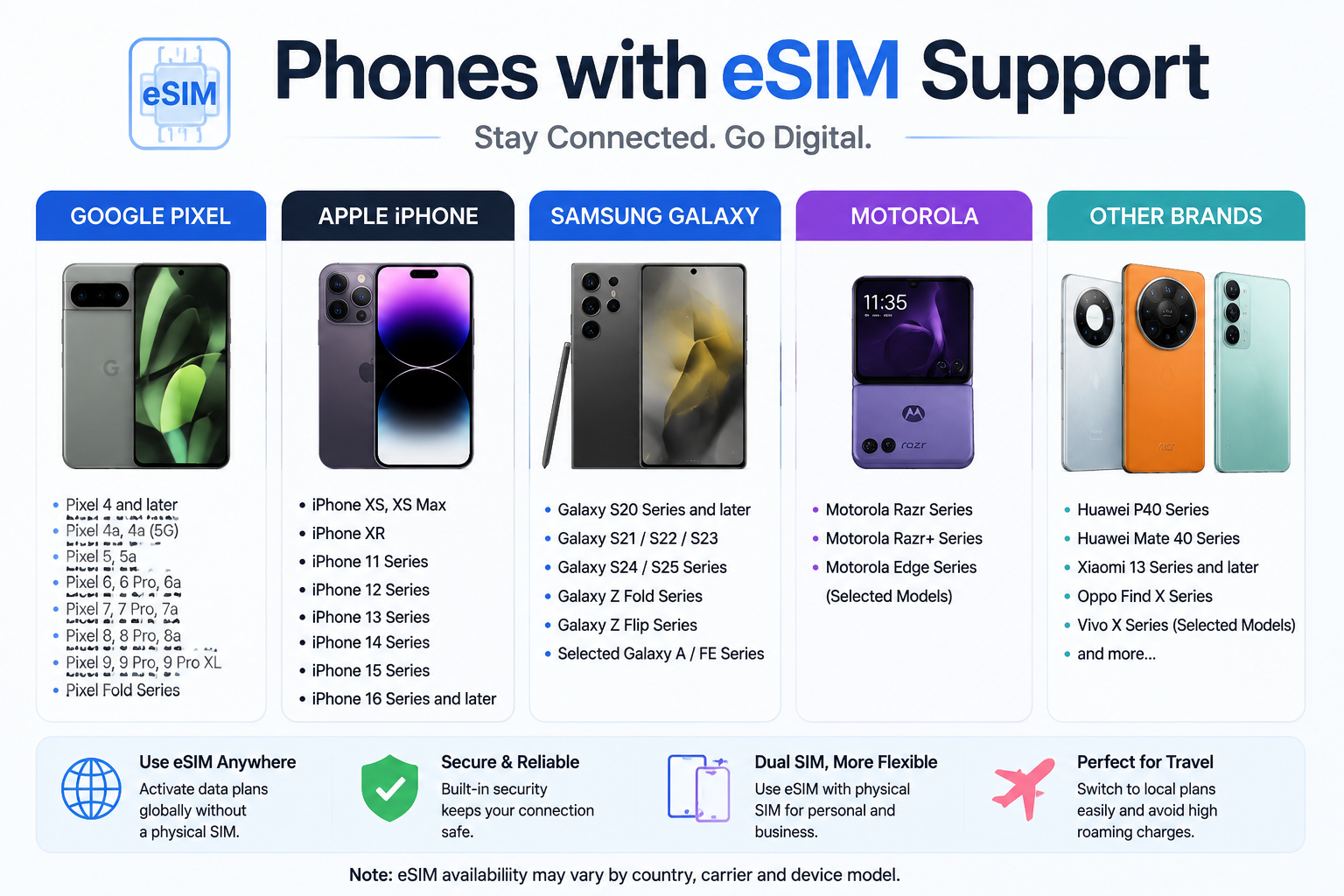
Google was one of the early smartphone manufacturers to adopt eSIM technology, especially through its Pixel lineup.
Popular Google Pixel smartphones with eSIM support include:
Google Pixel Series
- Google Pixel 3
- Google Pixel 3 XL
- Google Pixel 3a
- Google Pixel 3a XL
- Google Pixel 4
- Google Pixel 4 XL
- Google Pixel 4a
- Google Pixel 5
- Google Pixel 5a
- Google Pixel 6
- Google Pixel 6 Pro
- Google Pixel 6a
- Google Pixel 7
- Google Pixel 7 Pro
- Google Pixel 7a
- Google Pixel 8
- Google Pixel 8 Pro
- Google Pixel 8a
- Google Pixel Fold
- Google Pixel 9
- Google Pixel 9 Pro
- Google Pixel 9 Pro XL
- Google Pixel 9 Pro Fold
Google Pixel users can activate eSIM through Android settings when supported by their mobile operator.
Apple iPhone Models with eSIM Support
Apple has widely adopted eSIM technology across its latest iPhone lineup.
Supported models include:
iPhone XS Series and Newer
- iPhone XS
- iPhone XS Max
- iPhone XR
- iPhone 11 Series
- iPhone 12 Series
- iPhone 13 Series
- iPhone 14 Series
- iPhone 15 Series
- iPhone 16 Series
- Latest iPhone models
Apple introduced eSIM-only iPhone models in some regions, especially the US market, starting with the iPhone 14 series.
Samsung Galaxy Phones with eSIM Support
Samsung provides eSIM support mainly in its flagship Galaxy smartphones.
Popular supported models include:
Samsung Galaxy S Series
- Samsung Galaxy S20 Series
- Samsung Galaxy S21 Series
- Samsung Galaxy S22 Series
- Samsung Galaxy S23 Series
- Samsung Galaxy S24 Series
- Samsung Galaxy S25 Series
Samsung Galaxy Z Series
- Galaxy Z Fold Series
- Galaxy Z Flip Series
Samsung Galaxy Other Models
Selected Galaxy A and FE models may support eSIM depending on region and software availability.
Motorola Phones with eSIM Support
Motorola has introduced eSIM support in selected premium smartphones.
Supported models include:
- Motorola Razr Series
- Motorola Edge Series (selected models)
The Motorola Razr foldable smartphone was among the early Android devices to use eSIM-only connectivity.
Huawei Smartphones with eSIM Support
Selected Huawei smartphones support eSIM technology.
Examples include:
- Huawei P40
- Huawei P40 Pro
- Huawei Mate 40 Pro
Availability depends heavily on region because some Huawei models do not include eSIM support.
Xiaomi Phones with eSIM Support
Xiaomi has introduced eSIM support in selected premium devices and connected products.
Examples may include:
- Xiaomi flagship smartphones (selected models)
- Xiaomi smart devices with cellular connectivity
Users should confirm availability based on their country and model number.
Oppo Smartphones with eSIM Support
Selected Oppo devices support eSIM technology.
Examples include:
- Oppo Find Series (selected models)
Availability depends on region and telecom support.
Vivo Smartphones with eSIM Support
Vivo has started adopting eSIM technology in selected devices and connected products.
However, eSIM availability depends on:
- Smartphone model
- Country
- Software version
- Telecom operator
Users should verify compatibility before purchasing an eSIM plan.
How to Check If Your Phone Supports eSIM?
There are several ways to check eSIM compatibility.
Method 1: Check Phone Settings
Go to:
Settings → Network & Internet → SIM
If you see:
“Add eSIM” or “Download SIM”
your device likely supports eSIM.
Method 2: Check EID Number
Dial:
*#06#
If your phone displays an EID number, it usually indicates that the device has eSIM hardware support.
Method 3: Check Manufacturer Website
Always confirm with the official smartphone manufacturer because:
- Regional models may differ
- Carrier restrictions may apply
- Software support can vary
Important Things to Know Before Buying an eSIM Phone
Even if your smartphone supports eSIM, activation depends on additional factors.
Check:
1. Carrier Support
Your mobile operator must provide eSIM services.
2. Country Availability
Some smartphone variants support eSIM in one country but not another.
3. Unlocked Device
Carrier-locked smartphones may restrict eSIM activation.
4. Software Updates
Some devices require the latest software update to enable eSIM features.
Future of eSIM Supported Smartphones
The number of eSIM-supported smartphones is increasing every year.
Future devices may move toward:
- eSIM-only smartphones
- iSIM technology
- More connected IoT devices
- Seamless global connectivity
As telecom operators expand eSIM services, more affordable smartphones are expected to include eSIM support.
Final Note
eSIM support is no longer limited to flagship smartphones. Brands like Google, Apple and Samsung are leading the adoption, while other manufacturers are gradually adding the technology to more devices.
Before purchasing an eSIM plan, always check:
✔ Smartphone compatibility
✔ Regional model support
✔ Telecom operator availability
A compatible smartphone is the first requirement to enjoy the benefits of Google eSIM and digital SIM technology.
Benefits of Google eSIM
1. No Physical SIM Card Required
The biggest advantage of Google eSIM is eliminating the need for a physical SIM card.
Users do not need to worry about:
- Lost SIM cards
- Damaged SIM cards
- SIM tray problems
- Physical replacement
2. Faster Activation
With Google eSIM, users can activate mobile services digitally.
There is no need to visit a store, wait for delivery or insert a SIM card manually.
3. Better International Travel Experience
Google eSIM is extremely useful for travellers.
Users can purchase an international data plan and activate it digitally before travelling.
Advantages include:
- Avoiding expensive roaming charges
- Quick network access
- Easy switching between travel plans
4. Supports Multiple Numbers
Many eSIM-enabled smartphones allow users to store multiple profiles.
This is useful for:
- Personal number
- Business number
- Travel connectivity
More Benefits of Google eSIM
5. Improved Smartphone Design
One hidden advantage of Google eSIM technology is that it helps smartphone manufacturers create better device designs.
Removing the physical SIM tray provides additional internal space that can be used for:
- Larger batteries
- Better cooling systems
- Improved water resistance
- Additional hardware components
As eSIM adoption increases, future smartphones may completely remove physical SIM slots.
6. Better Security Compared to Physical SIM
A traditional SIM card can be removed easily from a stolen smartphone.
However, Google eSIM is integrated inside the device, making unauthorized removal much more difficult.
The SIM credentials remain protected inside the secure eUICC chip, providing an additional layer of security.
7. Environment-Friendly Technology
Physical SIM cards require plastic manufacturing, packaging and transportation.
Google eSIM reduces dependence on physical SIM production, helping create a more digital and environmentally friendly mobile ecosystem.
Disadvantages of Google eSIM
Although Google eSIM provides many advantages, it also has some limitations that users should consider.
1. Limited Carrier Support
The biggest challenge with eSIM technology is availability.
Not every mobile network provider supports eSIM services.
Before switching to Google eSIM, users should check:
- Telecom operator support
- Smartphone compatibility
- Regional availability
2. Switching Phones Can Be More Difficult
With a physical SIM card, transferring your number to another phone is simple:
Remove SIM → Insert into new phone → Start using.
With Google eSIM, transferring service may require:
- Carrier verification
- New QR code
- eSIM transfer process
The exact process depends on the telecom provider.
3. Activation Requires Internet Access
To activate Google eSIM, users usually need:
- Wi-Fi connection
- Mobile internet
- Carrier activation details
Without internet access, downloading the eSIM profile may not be possible.
4. Not All Devices Support eSIM
Many budget smartphones still use traditional SIM cards.
Before purchasing a device, users should check whether the smartphone supports eSIM functionality.
5. Less Convenient for Frequent Phone Changes
Users who regularly change smartphones may find physical SIM cards easier because they can quickly move the card between devices.
eSIM transfer is improving, but the process is still controlled by carriers.
How to Buy Google eSIM?
Many users think they need to purchase a separate “Google eSIM card”, but that is not correct.
An eSIM is a digital service provided by a telecom operator. Users purchase a mobile plan, and the operator provides the digital SIM profile.
The buying process involves the following steps.
Step 1: Check eSIM-Compatible Smartphone
First, confirm that your device supports eSIM.
For Google Pixel phones:
Go to:
Settings → Network & Internet → SIMs
If the option to add an eSIM is available, your phone supports the technology.
Step 2: Select a Supported Telecom Provider
Choose a mobile operator that provides eSIM services.
In India, major telecom operators offering eSIM support include:
- Reliance Jio
- Airtel
- Vodafone Idea (Vi)
Availability depends on your:
- Mobile circle
- Device model
- Operator policies
Step 3: Request eSIM Activation
Contact your telecom provider through:
- Official mobile app
- Customer care
- Telecom store
Request conversion from physical SIM to eSIM or request a new eSIM connection.
Step 4: Provide Required Details
The telecom operator may require:
- Mobile number
- Identity verification
- IMEI number
- EID number
The EID is a unique identification number associated with the smartphone’s eSIM hardware.
Step 5: Receive eSIM QR Code
After verification, the telecom provider sends:
- eSIM QR code
- Activation instructions
- Setup details
This QR code contains information required to download your mobile network profile.
How to Activate Google eSIM?
The activation process is simple.
Follow these steps:
Step 1:
Open:
Settings → Network & Internet
Step 2:
Select:
SIMs → Add SIM → Download a new eSIM
Step 3:
Scan the QR code provided by your telecom operator.
Step 4:
Allow your smartphone to download the eSIM profile.
Step 5:
Complete activation and select your preferred SIM settings.
After successful activation, your phone will connect to the mobile network.
How to Buy Travel eSIM for International Trips?
One of the biggest advantages of Google eSIM is international travel convenience.
Travellers can purchase travel eSIM plans online before reaching their destination.
The process:
- Select destination country.
- Choose a suitable data package.
- Purchase the plan online.
- Receive activation QR code.
- Scan QR code using smartphone settings.
- Activate the travel eSIM.
Benefits:
- No airport SIM shopping
- Instant internet access
- Affordable international data
- Easy switching between plans
Google eSIM and 5G Technology
The growth of 5G networks is increasing the importance of eSIM technology.
Modern users are connecting more devices than ever before, including:
- Smartphones
- Smartwatches
- Tablets
- Laptops
- IoT devices
eSIM technology makes it easier for these devices to connect with mobile networks without requiring physical SIM cards.
The combination of Google eSIM and 5G creates a more flexible and connected digital ecosystem.
Future of Google eSIM Technology
The future of Google eSIM looks very promising.
As smartphone manufacturers and telecom companies continue adopting digital connectivity, eSIM will become more common.
Future developments may include:
1. More eSIM-Only Smartphones
Some smartphone manufacturers may completely remove physical SIM slots in future models.
2. Growth of IoT Devices
eSIM technology will play an important role in:
- Smart cars
- Smart home devices
- Wearables
- Industrial IoT systems
3. Evolution from eSIM to iSIM
The next step after eSIM is iSIM (Integrated SIM) technology.
While eSIM uses a separate secure chip, iSIM integrates SIM functionality directly into the smartphone processor.
Benefits of iSIM may include:
- Smaller hardware design
- Lower power consumption
- Better integration with connected devices
Frequently Asked Questions About Google eSIM
What is Google eSIM?
Google eSIM is a digital SIM technology that allows compatible Google Pixel and Android smartphones to connect to mobile networks without using a physical SIM card.
Does Google Pixel support eSIM?
Yes, many Google Pixel smartphones support eSIM functionality, including Pixel 6, Pixel 7, Pixel 8, Pixel 9 and Pixel Fold series.
Is Google eSIM available in India?
Yes, major Indian telecom operators such as Jio, Airtel and Vi provide eSIM services for compatible devices.
Is eSIM better than physical SIM?
For most modern users, eSIM provides more flexibility, better security and easier digital activation. However, physical SIM cards can still be more convenient for users who frequently change phones.
Can I use physical SIM and eSIM together?
Yes, many smartphones support dual SIM functionality using one physical SIM and one eSIM.
Can eSIM be transferred to another phone?
Yes, but the transfer process depends on the telecom provider and may require verification.
Final Thoughts: Is Google eSIM the Future of Mobile Connectivity?
Google eSIM represents a major step forward in smartphone connectivity.
By replacing physical SIM cards with secure digital technology, eSIM provides users with:
- Faster activation
- Better security
- Easier network switching
- Improved travel connectivity
- More flexible smartphone designs
Although challenges like carrier availability and transfer complexity still exist, the advantages of eSIM technology are becoming increasingly valuable.
As 5G networks, smart devices and digital services continue to grow, Google eSIM will become an important technology shaping the future of mobile communication.
https://techvision.id/google-pixel-11-series-india/For Google Pixel users and modern smartphone buyers, choosing an eSIM-supported device provides a more convenient, secure and future-ready mobile experience.
One thought on “Google eSIM: Complete Guide to Technology, How It Works, Benefits, Pros & Cons, and Buying Guide in 2026”