


NVIDIA has entered another major phase of its artificial-intelligence expansion. The company’s latest earnings report showed $96.2 billion in quarterly revenue, while its Data Center business reached $89 billion. At the same time, NVIDIA is moving its next-generation Vera Rubin platform into production and expanding its infrastructure relationship with AWS to deploy 2 million additional NVIDIA GPUs.
The significance goes beyond one quarterly earnings report. NVIDIA is increasingly positioning itself as a complete AI infrastructure company, combining GPUs, CPUs, networking, software, AI models, robotics technology and large-scale data-center systems.
That makes NVIDIA one of the most important companies to watch in artificial intelligence, semiconductors and cloud computing in 2026.
Current status: The latest confirmed NVIDIA developments discussed in this article are based on announcements through August 28, 2026. Analyst views and future expectations are clearly separated from confirmed company announcements.
Table of Contents
Quick Facts About NVIDIA
| Fact | Details |
|---|---|
| Company | NVIDIA Corporation |
| Founded | April 5, 1993 |
| Founder & CEO | Jensen Huang |
| Headquarters | Santa Clara, California, USA |
| Stock ticker | NASDAQ: NVDA |
| Main business | Accelerated computing, AI infrastructure, GPUs and networking |
| Major areas | AI, data centers, gaming, robotics, automotive, simulation and professional visualization |
| Current AI platforms | Blackwell, Blackwell Ultra and Vera Rubin |
| Key software ecosystem | CUDA, NVIDIA AI Enterprise, NVIDIA NIM and related AI software |
| Major markets | Cloud computing, AI labs, enterprises, gaming, robotics, automotive and scientific computing |
It was founded in 1993 by Jensen Huang, Chris Malachowsky, and Curtis Priem. The company invented the GPU in 1999 and later turned GPU-based parallel computing into a foundation for modern AI. NVIDIA’s current headquarters are in Santa Clara, California, and its shares trade under the symbol NVDA.
Latest News: What Happened Recently?
Several developments have pushed NVIDIA back into the spotlight during the final week of August 2026.
1. Reports $96.2 Billion Quarterly Revenue
On August 26, 2026, NVIDIA announced results for the second quarter of fiscal 2027, covering the quarter ended July 26.
Revenue reached $96.221 billion, an increase of 18% from the previous quarter and 106% from the same quarter a year earlier. Data Center revenue reached $89 billion, up 117% year over year.
The results reinforced the continuing scale of AI infrastructure spending.
More importantly, NVIDIA’s outlook indicated that the company expects this growth to continue rather than representing a temporary peak.
2. Forecasts $108 Billion for the Next Quarter
It expects third-quarter fiscal 2027 revenue of approximately $108 billion, plus or minus 2%.
The company expects both GAAP and non-GAAP gross margins to be around 74% for the quarter. NVIDIA specifically said its outlook does not assume Data Center compute revenue from China.
That last point is important because China remains one of the major uncertainties surrounding NVIDIA’s international AI-chip business.
3. Vera Rubin Is Moving Into Full Production
it’s next major AI infrastructure platform, Vera Rubin, is now in full production.
it says Vera Rubin is designed for large-scale AI factories and agentic AI workloads. The company previously said the platform can deliver up to 10 times the agent throughput at scale compared with the previous-generation Grace Blackwell platform.
In its latest earnings announcement, NVIDIA said Vera Rubin systems are already running at partners including CoreWeave, Google Cloud, Microsoft Azure, Oracle Cloud Infrastructure and Nebius.
This means the AI infrastructure race is already moving beyond Blackwell toward the next generation.
4. AWS and NVIDIA Plan 2 Million Additional GPUs
One of the biggest announcements surrounding the latest earnings report came from AWS and NVIDIA.
On August 26, the companies announced plans to deploy 2 million additional NVIDIA GPUs across AWS’s global infrastructure.
The collaboration also extends beyond GPUs into CPUs, networking, open AI models, data processing and robotics.
This is significant because AWS is one of the world’s largest cloud infrastructure providers. Large deployments like this can translate into additional computing capacity for AI companies and enterprises around the world.
5. Expands Its AI Infrastructure Financing Strategy
Earlier in August, NVIDIA announced partnerships with Apollo, BlackRock, Blackstone, Brookfield, Goldman Sachs and KKR aimed at establishing AI-compute infrastructure financing platforms.
It said the initiative could mobilize more than $500 billion of third-party capital over time for AI infrastructure.
This is an important change in its role.
Instead of simply selling chips to data-center operators, It is increasingly participating in the broader infrastructure ecosystem required to build AI factories.
However, financing initiatives also create additional financial and execution risks, so investors are watching them carefully.
6. Introduces Jetson Orin Nano 2
NVIDIA also announced the Jetson Orin Nano 2 on August 25.
The new robotics computer is designed for entry-level edge AI and physical AI applications. NVIDIA says it delivers twice the inference performance of its predecessor in the same form factor while using 40% less power at the same performance level.
The announcement illustrates an important part of its strategy: AI isn’t staying inside enormous cloud data centers.
The company wants its technology to reach robots, drones, industrial machines and other edge devices.
Earnings: Latest Financial Performance
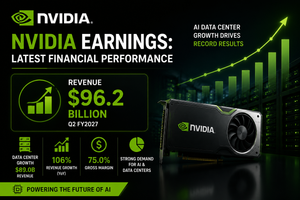
Its latest earnings report provides perhaps the clearest picture of the company’s current position.
Q2 Fiscal 2027 Results
| Metric | Q2 FY27 | Q1 FY27 | Q2 FY26 |
|---|---|---|---|
| Revenue | $96.22B | $81.62B | $46.74B |
| Revenue growth YoY | 106% | 85% | — |
| Data Center revenue | $89.0B | — | $41.1B |
| Gross margin | 75.0% | 74.9% | 72.4% |
| GAAP operating income | $63.73B | $53.54B | $28.44B |
| GAAP net income | $59.69B | $58.32B | $26.42B |
| GAAP diluted EPS | $2.46 | $2.39 | $1.08 |
| Non-GAAP diluted EPS | $2.22 | $1.87 | $1.01 |
Source: NVIDIA’s Q2 FY27 financial release.
The numbers show that NVIDIA’s growth remains heavily concentrated around Data Center and AI infrastructure.
Data Center revenue of $89 billion represented the overwhelming majority of quarterly revenue, highlighting how dramatically NVIDIA’s business has shifted from its traditional gaming roots toward AI computing.
NVIDIA also returned approximately $26 billion to shareholders during the quarter through share repurchases and cash dividends.
AI: Why the Company Matters So Much
IT’s importance to artificial intelligence is not simply about making fast GPUs.
Its advantage comes from combining hardware, networking, software and developer tools into a broader computing platform.
AI training
AI models require enormous computing resources during training. GPUs can process many mathematical operations simultaneously, making them highly suitable for large neural networks.
AI inference
After an AI model has been trained, it must respond to users.
That process is called inference.
As AI assistants, coding agents, and autonomous systems become more widely used, inference demand can become enormous. It is therefore designing its platforms for both training and inference.
Generative AI
Generative AI systems produce text, images, video, audio and code.
NVIDIA hardware provides much of the underlying computational infrastructure used to train and operate these systems.
Agentic AI
Agentic AI represents another important development.
Instead of simply answering a question, an AI agent can perform multiple steps, use tools, access information and complete tasks.
These workloads can consume significantly more computing resources than a simple chatbot interaction.
That is one reason it is emphasizing AI factories and inference infrastructure.
Physical AI
Physical AI refers to intelligent systems operating in the physical world.
Examples include:
- Robots
- Autonomous vehicles
- Industrial machines
- Delivery systems
- Drones
- Smart manufacturing equipment
NVIDIA’s latest robotics announcements show that it wants to participate in this next stage of AI development.
NVIDIA Vera Rubin: The Next Generation of AI Infrastructure
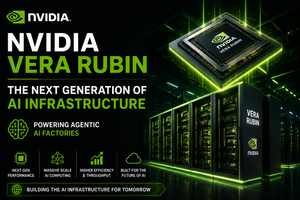
Vera Rubin is one of the most important NVIDIA technology developments to understand in 2026.
Rather than thinking of Rubin as simply another GPU, it is better understood as a large-scale computing platform.
NVIDIA’s Vera Rubin architecture brings together GPUs, CPUs, networking, storage and other components designed to operate as one AI infrastructure system.
The platform includes technologies such as:
- Rubin GPUs
- Vera CPUs
- NVLink 6
- ConnectX networking
- BlueField infrastructure processors
- Spectrum networking
- Groq 3 LPX inference accelerators
It says seven new chips associated with the platform entered full production as part of its March 2026 announcement.
Why Rubin matters
The AI industry is moving toward larger models and increasingly complex inference workloads.
A system designed only for training may not be enough.
Rubin is designed around the broader concept of an AI factory — infrastructure that continuously converts data and computing resources into AI-generated output.
IT says Vera Rubin is already ramping into full production and is being manufactured through a large global supply chain.
The company also says Rubin-based systems are being deployed at major cloud partners.
NVIDIA Blackwell: The Platform Powering Today’s AI Boom
Before Rubin becomes the next major growth platform, Blackwell remains central to IT’s current AI business.
Blackwell was introduced as a new GPU architecture for large-scale generative AI and accelerated computing.
NVIDIA’s Blackwell platform includes technologies designed to improve AI training and inference, networking and system-level performance.
Blackwell Ultra extends that architecture for AI reasoning, agentic AI and physical AI workloads.
It introduced Blackwell Ultra with systems including the GB300 NVL72 rack-scale platform and HGX B300 systems.
The broader transition can therefore be viewed as:
Hopper → Blackwell → Blackwell Ultra → Vera Rubin
Each generation is aimed at handling increasingly demanding AI workloads.
NVIDIA’s Latest Partnerships and Infrastructure Expansion
NVIDIA’s current strategy involves much more than selling individual GPUs.
AWS
The newly announced AWS agreement involving 2 million additional GPUs is one of the most significant current partnerships.
It also includes NVIDIA Vera CPUs, networking, Nemotron open models and physical AI technologies.
Cloud providers
IT’s latest financial release identified partners including CoreWeave, Google Cloud, Microsoft Azure, Oracle Cloud Infrastructure and Nebius as companies running Vera Rubin racks.
Financial institutions
IT’s August financing announcement involving major investment firms demonstrates an attempt to broaden access to capital for AI infrastructure construction.
The bigger picture is clear: IT wants its technology to sit at the center of an entire AI infrastructure ecosystem.
NVIDIA Stock: Why Investors Are Watching
Its stock remains closely tied to expectations surrounding artificial intelligence.
The latest earnings report was particularly important because investors wanted evidence that enormous AI infrastructure spending is continuing.
Reuters reported that its bullish outlook helped drive a major technology-stock rally, with IT shares rising sharply after the results.
However, strong business performance does not automatically mean a stock is cheap or guaranteed to rise.
Major factors investors are watching include:
AI demand:
Will businesses continue spending heavily on AI infrastructure?
Data Center growth:
Can it maintain extremely high Data Center revenue growth?
Rubin adoption:
How quickly will customers transition from Blackwell to Vera Rubin?
Margins:
NVIDIA expects its next-quarter gross margin to be approximately 74%, compared with 75% in Q2.
Competition:
AMD, custom accelerators and internally designed chips from large technology companies could increase competitive pressure.
Export restrictions:
Restrictions involving China could affect IT’s ability to sell certain advanced processors in the market.
Supply constraints:
High-bandwidth memory and other components remain important bottlenecks for the AI hardware industry.
Customer concentration:
Large cloud providers and AI companies represent significant sources of demand.
These factors mean IT’s stock should be viewed as a high-expectation technology investment rather than simply as a reflection of current earnings.
This article is informational and not personalized investment advice.
NVIDIA vs. AMD, Intel and Custom AI Chips
NVIDIA is not operating without competition.
| Area | NVIDIA | AMD | Intel | Custom AI Chips |
|---|---|---|---|---|
| AI GPUs | Major strength | Major competitor | Developing AI accelerator portfolio | Usually specialized |
| Data-center AI | Very strong | Growing | Competing | Strong for specific workloads |
| Software ecosystem | CUDA is a major advantage | ROCm ecosystem | OneAPI ecosystem | Usually company-specific |
| Networking | Major strength | Growing capabilities | Strong infrastructure history | Often integrated internally |
| Main advantage | Full-stack AI platform | Competitive AI accelerators | Broad computing portfolio | Workload-specific optimization |
The biggest competitive threat may not come from a single traditional chip company.
Large cloud and technology companies increasingly design custom silicon for particular AI workloads.
That can potentially reduce dependence on merchant GPU suppliers.
However, NVIDIA’s advantage is its broad ecosystem — GPUs, CPUs, networking, libraries, software, developer tools and systems working together.
Beyond AI
Although AI dominates today’s ITS headlines, the company still operates across several markets.
Gaming
IT GeForce GPUs remain important in PC gaming.
At Gamescom 2026, IT highlighted new RTX gaming developments, including DLSS 4.5-related features and support for upcoming games.
Robotics
IT is investing heavily in robotics and physical AI.
The Jetson Orin Nano 2 announcement is an example of how the company is pushing AI computing toward smaller edge devices.
Automotive
IT’s accelerated-computing platforms are also used in autonomous-driving and automotive development.
Digital twins and simulation
IT technologies are increasingly used to simulate factories, physical systems and engineering environments before they are built in the real world.
Scientific computing
Vera Rubin is also being positioned for scientific computing.
IT says Vera Rubin systems can provide large-scale AI and high-performance computing capabilities for areas including climate modeling, computational fluid dynamics and energy research.
What NVIDIA’s Latest Developments Mean for Consumers
Most consumers will not purchase a Vera Rubin server.
Nevertheless, IT technology can affect ordinary users indirectly.
Faster AI services
More powerful data centers can allow AI companies to provide more capable models and faster responses.
Better gaming
GPU improvements and AI-based graphics technologies can improve image quality, frame rates and gaming experiences.
AI PCs
IT’s technology is increasingly moving into personal AI computers and developer workstations.
For example, NVIDIA’s DGX Station for Windows is designed to allow enterprise users and developers to run very large AI models locally.
Robotics
Smaller AI computers such as Jetson Orin Nano 2 could help developers build more capable robots and autonomous machines.
Cloud applications
Consumers using AI assistants, image generators, coding tools and other cloud applications may indirectly depend on NVIDIA infrastructure.
Key Challenges Facing NVIDIA
NVIDIA’s growth story is powerful, but it also faces significant risks.
1. Competition
AMD and other accelerator companies are developing alternatives.
2. Custom silicon
Cloud providers can design chips specifically for their own workloads.
3. Supply constraints
AI systems require advanced memory, packaging, networking and manufacturing capacity.
4. Energy consumption
Large AI factories require enormous amounts of electricity and cooling infrastructure.
5. Data-center costs
AI infrastructure requires billions of dollars in capital investment.
6. Export restrictions
Geopolitical restrictions can affect IT’s ability to serve some international markets.
7. Customer concentration
A relatively small group of very large customers accounts for significant AI infrastructure spending.
8. Market expectations
Its enormous growth has created extremely high expectations.
Even excellent financial results could disappoint investors if future growth is slower than anticipated.
NVIDIA Future: What to Watch Next
The next phase of IT’s story will likely focus on execution rather than simply announcements.
Vera Rubin deployment
Watch how quickly Vera Rubin systems move from production into large-scale commercial deployment.
Blackwell demand
Blackwell remains an important part of IT’s current revenue engine.
AI inference
As AI agents become more widely used, inference could become an increasingly important source of computing demand.
AWS expansion
The planned deployment of 2 million additional GPUs will be an important infrastructure milestone.
AI financing
NVIDIA’s infrastructure-financing strategy will be worth watching because it could influence how AI data centers are funded.
Next earnings report
IT’s next quarterly results will provide another test of whether its $108 billion Q3 revenue outlook is on track. The company has already scheduled its financial-community presentation at the Goldman Sachs Communacopia + Technology Conference for September 10, 2026.
AI Infrastructure Summit
NVIDIA’s AI Infra Summit 2026 is scheduled for September 15–17, 2026, in Santa Clara, with a focus on infrastructure for agentic AI.
Confirmed Facts vs. Expectations
It is important to distinguish NVIDIA’s announcements from market speculation.
Confirmed
- Q2 FY2027 revenue reached $96.2 billion.
- Data Center revenue reached $89 billion.
- NVIDIA expects Q3 revenue of about $108 billion, ±2%.
- Vera Rubin is in full production.
- AWS and NVIDIA announced plans for 2 million additional GPUs.
- Jetson Orin Nano 2 was announced.
- NVIDIA has announced major AI infrastructure financing partnerships.
Company expectations
- Continued AI infrastructure demand.
- Growing Vera Rubin deployment.
- Continued expansion of agentic and physical AI.
- Continued growth across cloud, enterprise and AI-lab customers.
Analyst opinions
Analysts have generally responded positively to NVIDIA’s latest results and outlook, with several firms raising their expectations following the earnings announcement. These are opinions rather than guarantees of future performance.
Unconfirmed or speculative
Claims about future acquisitions, product launch dates beyond NVIDIA’s official announcements, or specific stock-price targets should not be treated as confirmed NVIDIA plans unless the company formally announces them.
Final Verdict: Why NVIDIA Still Matters in 2026
NVIDIA is no longer simply a graphics-chip company.
The company’s transformation from a gaming GPU manufacturer into a full-stack accelerated-computing and AI infrastructure company is one of the defining technology stories of the decade.
Its latest results show that demand remains exceptionally strong. $96.2 billion in quarterly revenue, $89 billion in Data Center revenue and a $108 billion Q3 revenue outlook demonstrate the extraordinary scale of the current AI infrastructure cycle.
At the technology level, the transition from Blackwell to Vera Rubin is becoming increasingly important. At the infrastructure level, partnerships such as the AWS plan for 2 million additional GPUs show how quickly AI computing capacity is expanding.
But NVIDIA also faces real challenges — competition, custom AI chips, supply constraints, energy requirements, export restrictions and extremely high market expectations.
For readers trying to understand NVIDIA in 2026, the most important point is this:
NVIDIA’s story is no longer only about GPUs. It is about who builds, supplies and controls the infrastructure that powers the next generation of artificial intelligence.
Sources
- NVIDIA Newsroom – Latest announcements and product updates
- NVIDIA Investor Relations – Earnings reports and financial results
- Reuters – Independent market and AI industry coverage


One thought on “NVIDIA: Latest News, AI Technology, Earnings, Products and What’s Happening in 2026”