


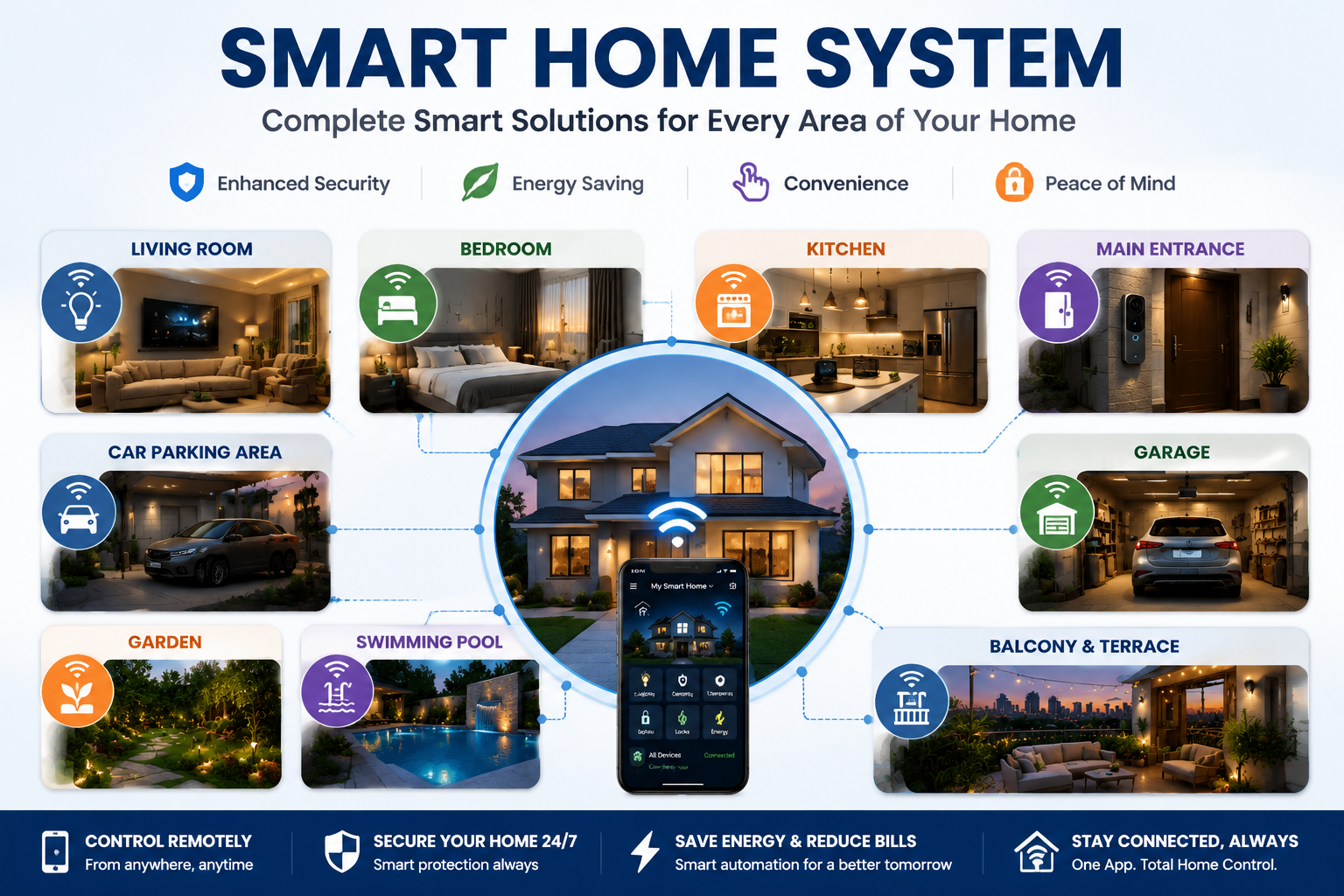
A smart home system is transforming the way people live by connecting everyday devices, appliances, security products and outdoor equipment into one intelligent and convenient environment. From smart lights and security cameras to smart locks, thermostats, garden irrigation, swimming pool controls and car parking security, modern smart home technology can help homeowners improve security, comfort, convenience and energy management.
Instead of manually controlling every device, homeowners can use a mobile app, voice commands, schedules and automated routines to manage compatible products. A smartphone can become a central control point for checking cameras, turning lights on or off, controlling compatible appliances, receiving security alerts and managing different areas of the property.
The most important advantage of a smart home system is that it can be expanded gradually. Homeowners do not need to make the entire property smart at once. They can start with a few useful devices and later connect the hall, bedroom, kitchen, entrance, garden, swimming pool, garage, car parking area, terrace and other spaces.
A complete smart home setup includes security, automation, energy management and connected devices. Learn more about building a complete Smart Home System for Security, Comfort and Energy Saving in 2026.
Smart security devices are only one part of a complete connected home. Explore our guide on creating a complete Smart Home System in 2026 with security, comfort and energy-saving solutions.
What Is a Smart Home System?
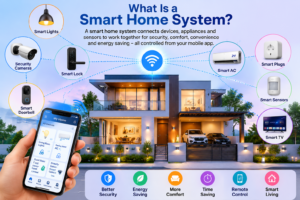
A smart home system is a network of connected devices that communicate through technologies such as Wi-Fi, Bluetooth, Thread, Ethernet and other supported wireless technologies. These devices can be controlled individually or combined into automated routines.
A typical system can include smart bulbs, smart switches, smart plugs, security cameras, video doorbells, smart locks, motion sensors, door and window sensors, smart speakers, smart displays, thermostats, energy monitors and connected appliances.
Modern interoperability standards such as Matter are designed to help compatible smart-home products from different manufacturers communicate more effectively. This can make it easier for consumers to build a connected home without being completely restricted to one manufacturer.
The exact features available depend on the device, ecosystem, region and internet connection. Therefore, buyers should always check compatibility before purchasing smart home products.
How Does a Smart Home System Work?
The basic operation of a smart home system is straightforward. Compatible devices are connected to a home network and added to a supported smart-home platform or manufacturer’s application. Once connected, users can control individual products or create automation routines.
For example, a homeowner could use a smartphone to switch off a smart light from another room. A motion sensor could automatically turn on a hallway light when movement is detected. A door sensor could send an alert when a door is opened. A compatible smart lock could provide keyless access, while a security camera could allow the homeowner to check the property remotely.
The real benefit comes when several devices work together. A “Good Night” routine could switch off selected lights, adjust compatible temperature controls, check selected doors and activate appropriate security devices. An “Away Mode” could turn off selected appliances, activate security monitoring and adjust compatible devices when the family leaves home.
Smart Home System for the Hall or Living Room
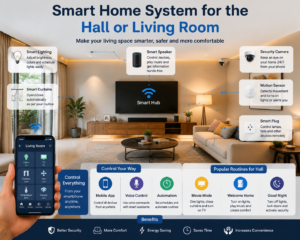
The hall or living room is often the best starting point for a smart home system because it is one of the most frequently used areas of a home. A smart speaker or smart display can provide a convenient central control point for compatible devices.
Smart bulbs and smart switches can provide scheduled or adjustable lighting, while smart plugs can control suitable connected appliances. A security camera positioned in an appropriate common area or near an entrance can provide additional monitoring.
A living-room “Movie Mode” could dim compatible lights, activate selected entertainment devices and adjust other connected products. A “Welcome Home” routine could turn on selected lights and prepare the room when the homeowner arrives.
Smart Home System for the Bedroom
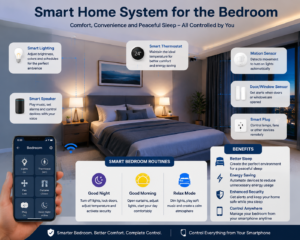
The bedroom is another important area for smart home automation because comfort and convenience are particularly valuable at night. Smart bulbs can provide scheduled lighting, while smart plugs can control suitable lamps and other compatible devices.
A compatible temperature-control device can help manage the room environment according to a predefined schedule. Sensors can also monitor movement, temperature or door activity, depending on the products installed.
A useful “Good Night” routine could switch off selected lights, adjust compatible temperature controls and activate suitable security settings. In the morning, a “Good Morning” routine could gradually activate selected lights and other compatible devices.
Privacy should be considered carefully when installing cameras or microphones in bedrooms or other private spaces. Users should review device permissions, privacy settings and account security before connecting such products.
Smart Home System for the Kitchen
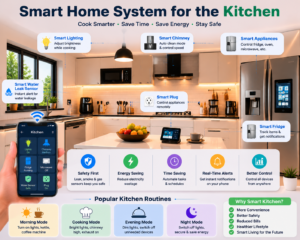
The kitchen can benefit from smart lighting, smart plugs, connected appliances, water-leak sensors and safety devices. Smart lighting can improve visibility, while suitable smart plugs can schedule or remotely control compatible appliances.
Water-leak sensors can be useful near washing machines, sinks and water connections. Smart smoke or carbon-monoxide sensors, where suitable and legally appropriate, can provide additional warnings.
A “Kitchen Morning” routine could activate selected lights and compatible devices. However, high-power appliances should only be connected to smart plugs or controllers that are specifically rated for their electrical load. Smart automation should never be configured in a way that creates a fire, overheating or other safety risk.
Smart Home System for the Main Entrance
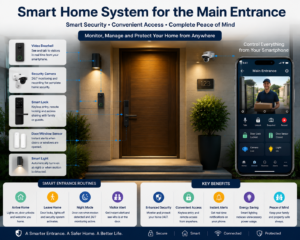
The main entrance is one of the most important areas for a smart home security system. A video doorbell can notify homeowners when someone approaches the door, while a security camera can provide additional visual monitoring.
A compatible smart lock can provide keyless access and allow authorized users to manage access through a mobile application. Depending on the ecosystem, cameras, doorbells, locks and lighting can be integrated into a single security routine.
For example, when motion is detected at night, compatible entrance lights could turn on while the homeowner receives an alert on their smartphone.
Smart Home System for the Main Gate
For independent houses and larger properties, the main gate can become an important part of the connected security system. A smart gate controller, outdoor security camera and smart lighting can provide greater visibility and convenience.
When somebody approaches the gate, a compatible camera or sensor can send an alert to the homeowner. The homeowner can then check the visitor before deciding whether to open the gate.
A smart gate should always be installed and configured according to the manufacturer’s safety instructions. Remote access should also be protected with strong account security.
Smart Home System for the Car Parking Area
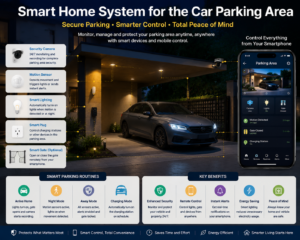
The car parking area can benefit significantly from smart home security technology. An outdoor security camera can monitor vehicles and the surrounding area, while motion sensors can activate suitable lights when movement is detected.
Smart outdoor lighting can automatically illuminate the parking area at night, improving visibility when family members arrive home. A compatible camera can also provide remote monitoring through a mobile app.
A useful “Arriving Home” routine could activate the parking-area lights and selected entrance devices. If a smart gate controller is installed, it may also provide authorized remote gate control, depending on the product.
Smart Home System for the Garage
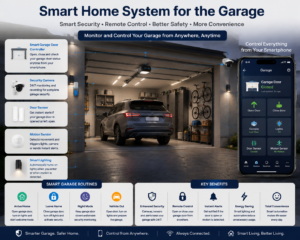
A smart garage can improve both security and convenience. A compatible smart garage-door controller can allow homeowners to check the door status and, where supported, control it through a smartphone.
Sensors can send notifications if the garage door remains open, while cameras can monitor the garage entrance. Motion-activated lighting can make the area easier to use at night.
Garage-door automation should always use products specifically designed for the intended garage-door system and should follow the manufacturer’s safety requirements.
Smart Home System for the Garden
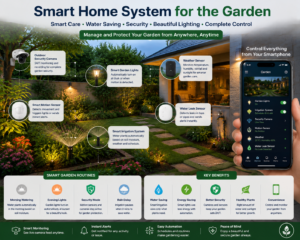
The garden is another area where smart home automation can provide practical benefits. Smart irrigation controllers can schedule watering according to programmed timings and, where supported, environmental or weather information.
Smart outdoor lights can automatically turn on after sunset or according to a schedule. Motion sensors can activate selected lights when movement is detected.
A connected garden can also include outdoor security cameras, water-leak sensors and environmental sensors. Through a mobile app, homeowners can check the status of compatible garden equipment without manually inspecting every area.
Smart Home System for the Swimming Pool
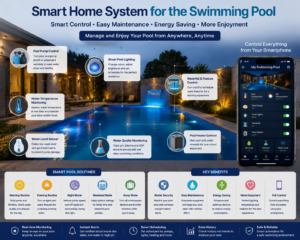
A swimming pool can also become part of a connected smart home system. Compatible pool controllers can help homeowners manage suitable equipment such as pumps, filtration systems, pool lighting and temperature controls.
Smart pool lighting can improve the appearance of the pool area during the evening. Timers and automation can help operate suitable equipment according to a schedule.
Depending on the available technology, water-level or leak sensors can provide additional monitoring. An outdoor security camera can also help monitor the pool area.
However, smart technology should never replace proper swimming-pool safety measures, barriers, supervision or legally required safety equipment. It should be considered an additional layer of monitoring and convenience.
Smart Home System for the Backyard
The backyard can be connected using outdoor security cameras, motion sensors, smart lighting and environmental sensors. This can be especially useful for larger properties where the backyard is away from the main entrance.
Motion detection can automatically activate selected lights, while cameras can provide visual monitoring. Smart irrigation can also help maintain plants and lawns according to a programmed schedule.
Smart Home System for the Balcony and Terrace
Table of Contents
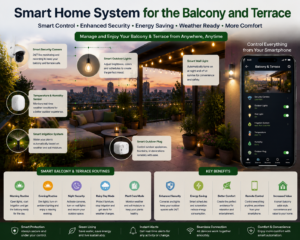
Balconies and terraces can benefit from smart lighting, cameras, sensors and irrigation systems. Outdoor lights can be scheduled to activate in the evening, while motion sensors can provide additional security.
For terraces with plants, compatible irrigation technology can automate watering. Outdoor cameras can provide additional monitoring if the area is accessible from another part of the property.
Smart Home System for the Entrance Pathway
Pathways connecting the main gate, parking area and house can benefit from smart outdoor lighting and motion sensors.
Instead of keeping lights switched on throughout the night, motion sensors can activate suitable lights when someone enters the pathway. This can improve visibility while potentially reducing unnecessary electricity consumption.
For larger properties, multiple lighting zones can be controlled separately through a mobile app.
Smart Home System for the Staircase and Passage
Motion sensors can be particularly useful for staircases and passageways. Instead of leaving lights on continuously, suitable lights can automatically activate when movement is detected.
At night, low-level lighting can operate for a limited period, providing convenient visibility while reducing unnecessary lighting usage.
Smart Home System for the Laundry Area
The laundry area can benefit from water-leak sensors, smart plugs and energy-monitoring devices. A water sensor placed near a washing machine or water connection can provide an early warning if a leak occurs.
Energy-monitoring devices can also help homeowners understand electricity consumption. High-power appliances should only be connected to devices that are specifically rated for their electrical requirements.
Smart Home System for the Home Office
A home office can use smart lighting, smart plugs, temperature controls and smart speakers to create a comfortable working environment.
A “Work Mode” routine could turn on the desk light, adjust compatible temperature controls and activate selected devices. At the end of the working schedule, another routine could switch off selected equipment.
This type of automation can reduce repetitive actions and create a more consistent working environment.
Smart Home System for Children’s Rooms
Children’s rooms can use smart lighting, suitable environmental sensors and scheduled devices. Smart night lights can provide gentle lighting during bedtime, while temperature sensors can help monitor room conditions.
Parents should carefully consider privacy and safety before installing cameras or microphones in children’s rooms. Connected devices should use strong account security and appropriate privacy settings.
Smart Home System for Energy Saving
Energy management is one of the most valuable applications of a smart home system. Smart lights can automatically switch off when they are not required, while smart plugs can schedule suitable appliances.
Compatible thermostats and air-conditioner controllers can help homeowners manage temperature schedules. Energy-monitoring devices can provide information about household consumption.
Some modern smart-home ecosystems are also introducing AI-assisted energy-management features. Samsung SmartThings, for example, offers AI Energy Mode for supported connected devices.
However, smart devices do not automatically guarantee lower electricity bills. Actual savings depend on how the system is configured and how household electricity is consumed.
How to Control a Smart Home Through a Mobile App
One of the biggest advantages of a smart home system is smartphone control. After compatible devices are connected to the appropriate platform, homeowners can use a mobile application to monitor and control their connected products.
A smartphone dashboard can show lights, cameras, sensors, plugs and other compatible devices. Users may be able to switch off lights remotely, check camera feeds, receive security alerts and manage automation routines.
Matter-compatible devices can also support control through compatible smart-home ecosystems, although the exact features depend on the device and platform. Google’s documentation describes Matter support through Google Home and compatible controllers, while Apple supports Matter accessories through its Home ecosystem.
Mobile App vs Voice Control vs Automation
| Control Method | How It Works | Best For | Convenience |
|---|---|---|---|
| Mobile App | Control devices using a smartphone | Remote control | ★★★★★ |
| Voice Control | Use a supported voice assistant | Hands-free control | ★★★★★ |
| Automation | Devices respond automatically | Daily routines | ★★★★★ |
| Smart Display | Visual control from a central screen | Family/shared control | ★★★★☆ |
| Physical Switch | Traditional manual control | Backup/manual operation | ★★★★★ |
The best smart home system does not necessarily require homeowners to control everything through their phones. A combination of mobile apps, voice commands, automation and physical switches can provide a more reliable experience.
Top Smart Home Devices for Security, Comfort and Energy Saving
| Smart Home Device | Main Purpose | Best Location | Main Benefit |
| Smart Security Camera | Security monitoring | Entrance/Hall/Parking | Remote monitoring |
| Video Doorbell | Door security | Main entrance | Visitor alerts |
| Smart Lock | Access control | Main door | Keyless entry |
| Smart Gate Controller | Gate control | Main gate | Convenient access |
| Smart Garage Controller | Garage control | Garage | Remote status/control |
| Smart Motion Sensor | Movement detection | Hall/Garden/Parking | Security & automation |
| Door/Window Sensor | Opening alerts | Doors/Windows | Security |
| Smart Bulb | Lighting control | Hall/Bedroom/Garden | Convenience |
| Smart Plug | Appliance control | Kitchen/Bedroom | Scheduling |
| Smart Thermostat/AC Controller | Temperature management | Bedroom/Hall | Comfort & energy control |
| Smart Speaker/Display | Central control | Hall/Bedroom | Voice & app control |
| Smart Energy Monitor | Energy tracking | Home-wide | Energy awareness |
| Smart Irrigation Controller | Garden watering | Garden | Water management |
| Smart Pool Controller | Pool management | Swimming pool | Convenience |
| Leak Sensor | Leak detection | Kitchen/Laundry/Pool | Early warning |
Comparative Chart: Smart Home Devices
| Device | Security | Comfort | Energy Saving | Mobile Control |
| Security Camera | ★★★★★ | ★★☆☆☆ | ★☆☆☆☆ | ★★★★★ |
| Video Doorbell | ★★★★★ | ★★★☆☆ | ★☆☆☆☆ | ★★★★★ |
| Smart Lock | ★★★★★ | ★★★★★ | ★☆☆☆☆ | ★★★★★ |
| Smart Bulb | ★★☆☆☆ | ★★★★★ | ★★★★☆ | ★★★★★ |
| Smart Plug | ★★☆☆☆ | ★★★★☆ | ★★★★★ | ★★★★★ |
| Motion Sensor | ★★★★☆ | ★★★★☆ | ★★★★☆ | ★★★★☆ |
| Smart Thermostat | ★★☆☆☆ | ★★★★★ | ★★★★★ | ★★★★★ |
| Smart Speaker | ★★☆☆☆ | ★★★★★ | ★★☆☆☆ | ★★★★★ |
| Smart Energy Monitor | ★★★☆☆ | ★★☆☆☆ | ★★★★★ | ★★★★★ |
| Smart Irrigation | ★☆☆☆☆ | ★★★★☆ | ★★★★★ | ★★★★★ |
| Smart Pool Controller | ★★★☆☆ | ★★★★★ | ★★★★☆ | ★★★★★ |
| Smart Gate Controller | ★★★★★ | ★★★★☆ | ★☆☆☆☆ | ★★★★★ |
Smart Home System: Pros and Cons
The first major advantage of a smart home system is convenience. Homeowners can control multiple devices from a smartphone, voice assistant or automated routine. This can be particularly useful for busy families and people who want to reduce repetitive household tasks.
The second major advantage is security. Cameras, doorbells, sensors, smart locks and outdoor lighting can provide better visibility and notifications. Homeowners can potentially monitor their property even when they are away.
Energy management is another important advantage. Smart lighting, plugs, temperature controls and energy monitors can help reduce unnecessary operation and improve awareness of household energy consumption.
Another benefit is personalization. Different rooms and outdoor areas can have different routines. The hall can have an entertainment routine, the bedroom can have a sleep routine, the kitchen can have a morning routine, and the garden can have an irrigation schedule.
However, there are also disadvantages. The initial cost can be higher than traditional devices, particularly when cameras, locks, sensors and connected appliances are installed throughout a property.
Compatibility can also be challenging. Not every product works with every smart-home ecosystem. Matter is designed to improve interoperability, but consumers should still check exact product compatibility before purchasing.
Privacy and cybersecurity are additional considerations. Cameras, microphones, sensors and other connected devices can provide information about household activity. Users should use strong passwords, enable available security features, update firmware and purchase products from reputable manufacturers.
Internet or network problems can also affect some smart-home functions. Devices that support local control may continue to perform certain actions without cloud connectivity, but functionality varies between products.
Smart Home System Pros and Cons Comparison
| Pros | Cons |
| Remote smartphone control | Higher initial investment |
| Better security monitoring | Compatibility issues |
| Energy-saving automation | Setup can take time |
| Voice control | Privacy considerations |
| Customized routines | Some features require internet |
| Remote property monitoring | Software updates are required |
| Room-by-room automation | Some products require hubs |
| Outdoor property management | Installation may require professionals |
Smart Home Areas Comparison
| Area | Recommended Smart Devices | Main Benefit |
| Hall/Living Room | Lights, speaker, display, camera | Comfort & control |
| Bedroom | Lights, sensors, temperature control | Comfort |
| Kitchen | Plugs, sensors, smart appliances | Convenience & safety |
| Main Entrance | Doorbell, camera, lock | Security |
| Main Gate | Camera, gate controller, lights | Access control |
| Car Parking | Camera, motion sensor, lights | Security |
| Garage | Door controller, camera, sensors | Security & convenience |
| Swimming Pool | Pool controller, lights, sensors | Maintenance & safety |
| Garden | Irrigation, lights, sensors | Water management |
| Backyard | Camera, motion sensor, lights | Security |
| Balcony | Lights, camera, sensors | Security & convenience |
| Terrace | Lights, irrigation, sensors | Comfort & maintenance |
| Laundry Area | Leak sensor, energy monitor | Safety |
| Staircase | Motion sensor, smart lights | Convenience |
| Home Office | Lights, plugs, temperature control | Productivity |
| Pathway | Motion sensors, outdoor lights | Visibility |
Where to Buy Smart Home Devices
Smart home products are available through official manufacturer stores, authorized electronics retailers and major online marketplaces. Before buying, homeowners should compare ecosystem compatibility, Matter support where relevant, mobile-app functionality, warranty, installation requirements, Wi-Fi or Thread support, privacy features and after-sales service.
It is generally better to start with products that solve an immediate problem instead of purchasing many devices at once. Smart bulbs, smart plugs, motion sensors or a smart speaker can provide a relatively simple introduction to smart-home technology.
After understanding the ecosystem, homeowners can gradually add security cameras, doorbells, smart locks, garden irrigation, pool controls, gate controllers, garage automation and energy-management devices.
When buying online, check the exact model, seller, warranty, regional compatibility, electrical specifications and installation requirements. This is especially important when purchasing electrical products or products intended for outdoor use.
How to Build a Smart Home System on a Budget
A smart home system does not have to be expensive from the beginning. The most practical approach is to start with one area and gradually expand.
Stage 1 can include smart bulbs, smart plugs and a smart speaker.
Stage 2 can add motion sensors, door/window sensors and security cameras.
Stage 3 can add a video doorbell, smart lock and gate or garage controller.
Stage 4 can add garden irrigation, energy monitoring, pool automation and connected appliances.
This gradual approach helps homeowners control costs while learning how different devices and automation routines work.
The Future of Smart Home Systems
The future of the smart home system is expected to move beyond simple remote control toward more intelligent automation. Instead of manually operating every device, future systems may increasingly understand household routines, environmental conditions and user preferences.
Current smart-home development already shows this direction. Samsung describes an AI Home approach in which connected appliances and devices work together to provide more personalized comfort, security, care and energy efficiency.
Interoperability will also become increasingly important. Matter is designed to provide a common standard for compatible smart-home devices and supports categories including lighting, electrical devices, locks, HVAC controls, sensors and safety/security products.
AI-powered automation could become one of the biggest developments. Instead of creating many individual routines, homeowners may eventually be able to describe their desired outcome in natural language. For example, a user could request a comfortable evening environment and the system could coordinate compatible lighting, temperature controls and entertainment devices.
Energy management is another major opportunity. Future smart homes may coordinate air conditioners, appliances, solar systems, batteries and electric-vehicle charging to improve energy efficiency where compatible technology is available.
One Smart Home, One Connected Property
The future of home automation is not limited to indoor rooms. A complete smart home system can connect the hall, bedroom, kitchen, main entrance, main gate, car parking area, garage, swimming pool, garden, backyard, balcony, terrace, pathway and other areas of the property.
For example, an “Away Mode” could switch off selected lights, adjust compatible temperature controls and activate security devices. An “Arrive Home” routine could activate parking and entrance lights and prepare selected areas of the house.
An “Evening Mode” could activate garden and pathway lighting, while a “Night Mode” could turn off selected indoor lights, secure compatible entrances and activate appropriate security monitoring.
This demonstrates the real potential of smart-home technology: individual products become more useful when they work together as one connected system.
Final Verdict
A smart home system can make modern homes safer, more comfortable, convenient and energy-conscious when it is designed around real household needs. The best smart home is not necessarily the one with the largest number of devices. Instead, it should be reliable, easy to control, secure and compatible with the homeowner’s preferred ecosystem.
For security, smart cameras, video doorbells, motion sensors, door sensors, smart locks, gate controllers and outdoor lighting can provide useful protection and monitoring.
For comfort, smart lights, speakers, displays, temperature controls and automated routines can make everyday activities easier.
For energy saving, smart plugs, lighting schedules, temperature management, irrigation controls and energy monitors can help reduce unnecessary consumption and improve awareness.
For outdoor areas, smart garden irrigation, swimming pool controls, parking cameras, garage automation, gate controllers, pathway lighting and backyard security can extend automation beyond the walls of the house.
The future of the smart home system is likely to become more connected, intelligent and personalized. AI, interoperability standards such as Matter, energy management and improved mobile applications could make future homes increasingly capable of responding automatically to household requirements.
For homeowners starting today, the smartest approach is to start small, choose compatible devices, prioritize security and privacy, and expand the system room by room and area by area. With the right combination of devices, the home can evolve into a connected property where security, comfort, convenience and energy management work together.
2 thoughts on “Smart Home System: Top Devices for Security, Comfort and Energy Saving in 2026”