


Introduction
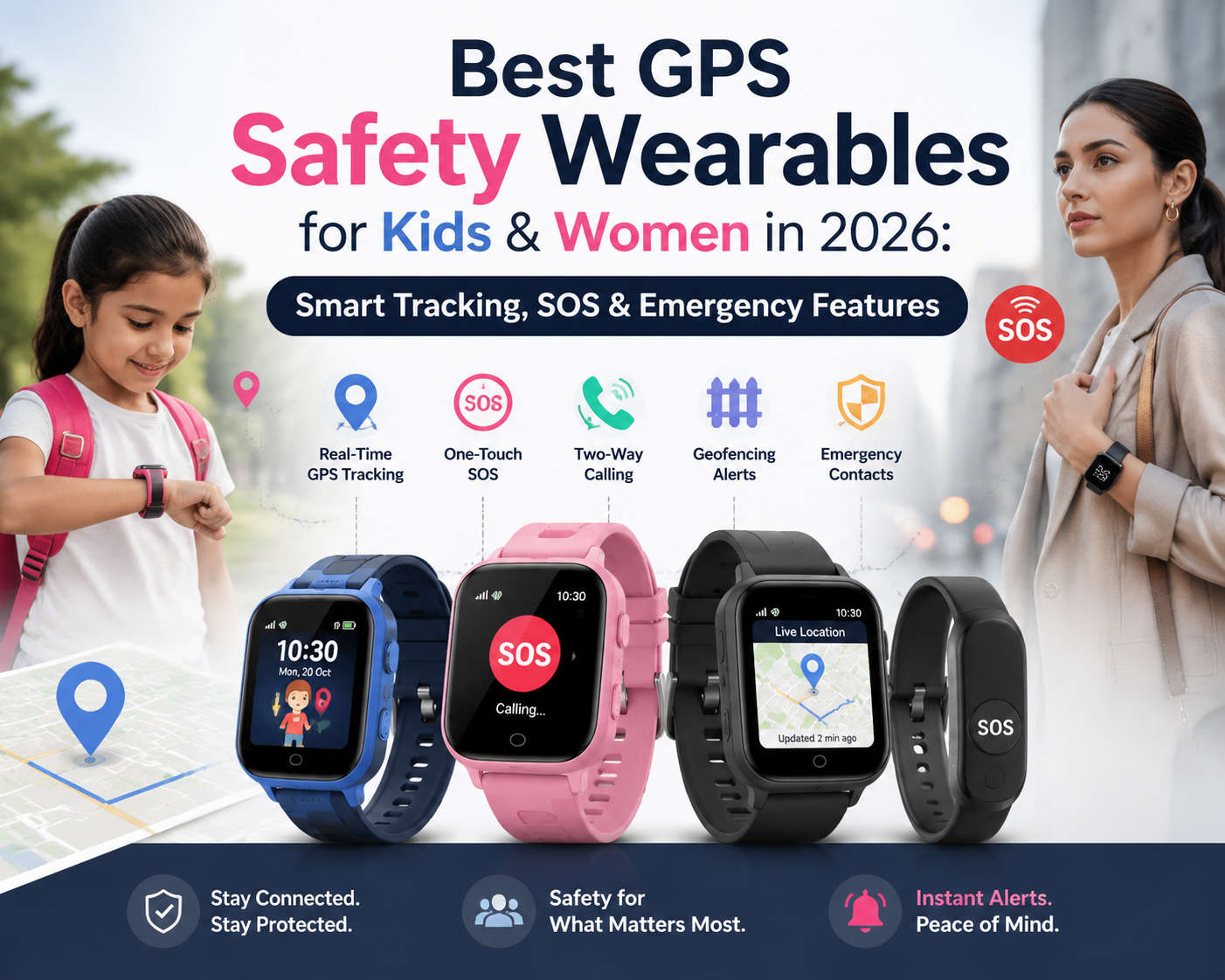
Best GPS Safety Wearables for Kids & Women in 2026 are becoming essential smart safety solutions that combine advanced GPS tracking, SOS alerts, emergency communication, and real-time location sharing. With growing concerns about child safety, personal security, and emergency situations, GPS-enabled wearables are helping families stay connected and respond quickly when support is needed.
Modern safety wearables are no longer limited to simple location tracking. The latest devices offer features such as live GPS monitoring, one-touch SOS buttons, geofencing, two-way calling, emergency contacts, fall detection, and smart notifications. These features make them valuable tools for parents who want to monitor their children’s safety and for women who need quick access to emergency assistance.
For kids, GPS smartwatches can provide parents with peace of mind while children travel to school, attend tuition classes, play outdoors, or visit crowded places. For women, compact safety wearables with GPS and SOS functions can provide an additional layer of protection during travel, commuting, outdoor activities, and emergency situations.
In 2026, the wearable technology market is moving towards smarter and more reliable safety devices by combining GPS technology, cellular connectivity, artificial intelligence, and health sensors. However, choosing the right wearable requires understanding important factors such as location accuracy, battery life, network support, privacy features, subscription costs, and emergency response capabilities.
This detailed guide explores the best GPS safety wearables for kids and women in 2026, comparing their smart tracking features, SOS functions, communication options, and safety benefits to help you select the right device for your needs.
This connected ecosystem is also expanding into wearable technology, with smart devices designed for entertainment, communication, health monitoring, and personal safety.
The growth of wearable technology shows how personal devices are becoming smarter and more useful. Similar to smartphones and wireless accessories, modern safety wearables combine connectivity, smart features, and convenience to support different user needs. Choosing the right device depends on factors such as tracking accuracy, emergency features, battery performance, and overall reliability.
Table of Contents
What Are GPS Safety Wearables?
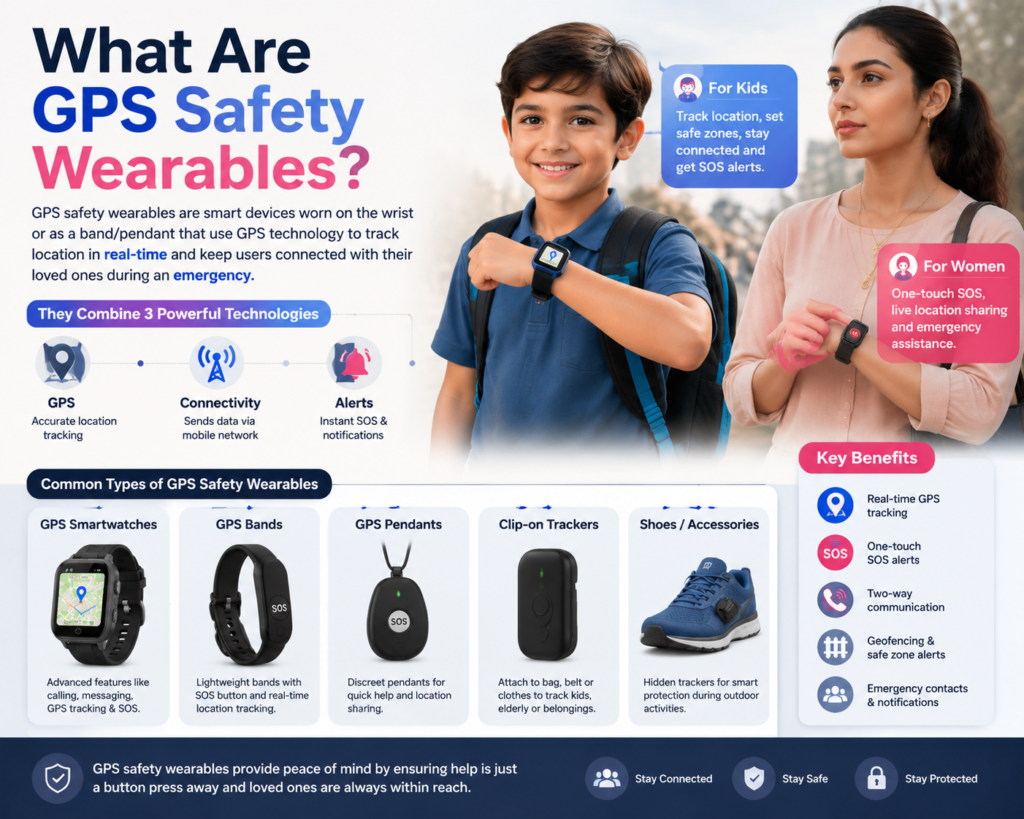
GPS safety wearables are wearable electronic devices that use GPS or other satellite-positioning technologies to determine a user’s location and communicate that information to a smartphone, family member or emergency contact.
They can take several forms:
- GPS smartwatches
- Kids’ smartwatches
- Cellular smartwatches
- GPS safety bands
- Personal SOS devices
- Clip-on safety trackers
- GPS-enabled wearable devices
Unlike a conventional fitness tracker, a safety-focused wearable prioritizes communication, location and emergency assistance.
For children, the device may allow parents to see their child’s location or receive alerts when the child enters or leaves a predefined area. For women, the emphasis may be on discreet SOS activation, live location sharing and emergency communication.
Why GPS Safety Wearables Matter in 2026
Smartphones are useful safety tools, but they are not always the best solution.
A child may forget a phone at home, lose it in a school bag or struggle to unlock it quickly during an emergency. Similarly, a woman walking, travelling or working may not always have both hands available to operate a smartphone.
A wearable stays attached to the person and can provide faster access to selected safety functions.
Modern kids’ GPS wearables increasingly focus on location tracking, approved contacts, geofencing and SOS functions rather than unrestricted smartphone-style applications.
Best GPS Safety Wearables for Kids & Women in 2026
There is no single device that is perfect for everyone. The right choice depends on the user’s age, smartphone ecosystem, cellular availability, budget and required safety features.
1. Garmin Bounce 2 – Strong Choice for Kids
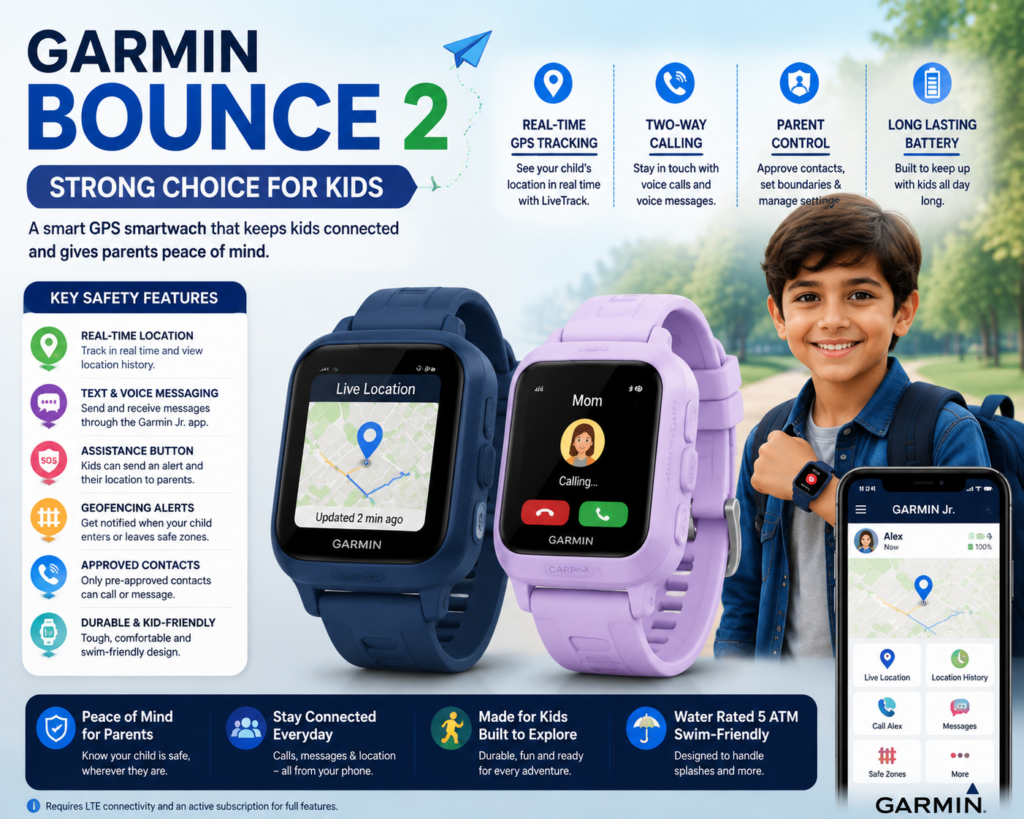
Garmin Bounce 2 is one of the most interesting dedicated kids’ smartwatches for families looking for communication and location features.
Garmin says Bounce 2 provides LTE connectivity, real-time location tracking, two-way calling and messaging. Parents can use the Garmin Jr. app to communicate with and locate the child.
Key safety features
- Real-time location tracking
- Two-way calling
- Voice messaging
- Text messaging
- Location history
- Parent-defined geofencing
- Assistance feature
- Parent-controlled contacts
- LTE connectivity
The watch can also allow guardians to request the child’s location through LiveTrack.
Best for: Parents who want a dedicated communication and tracking watch instead of giving a child a smartphone.
Important limitation: Garmin states that its safety and tracking features are supplemental and should not be relied upon as the primary method of obtaining emergency assistance. LTE connectivity and an active subscription are required for relevant features.
Our verdict: ⭐⭐⭐⭐⭐
Safety focus: Excellent
Best feature: Real-time child location + communication
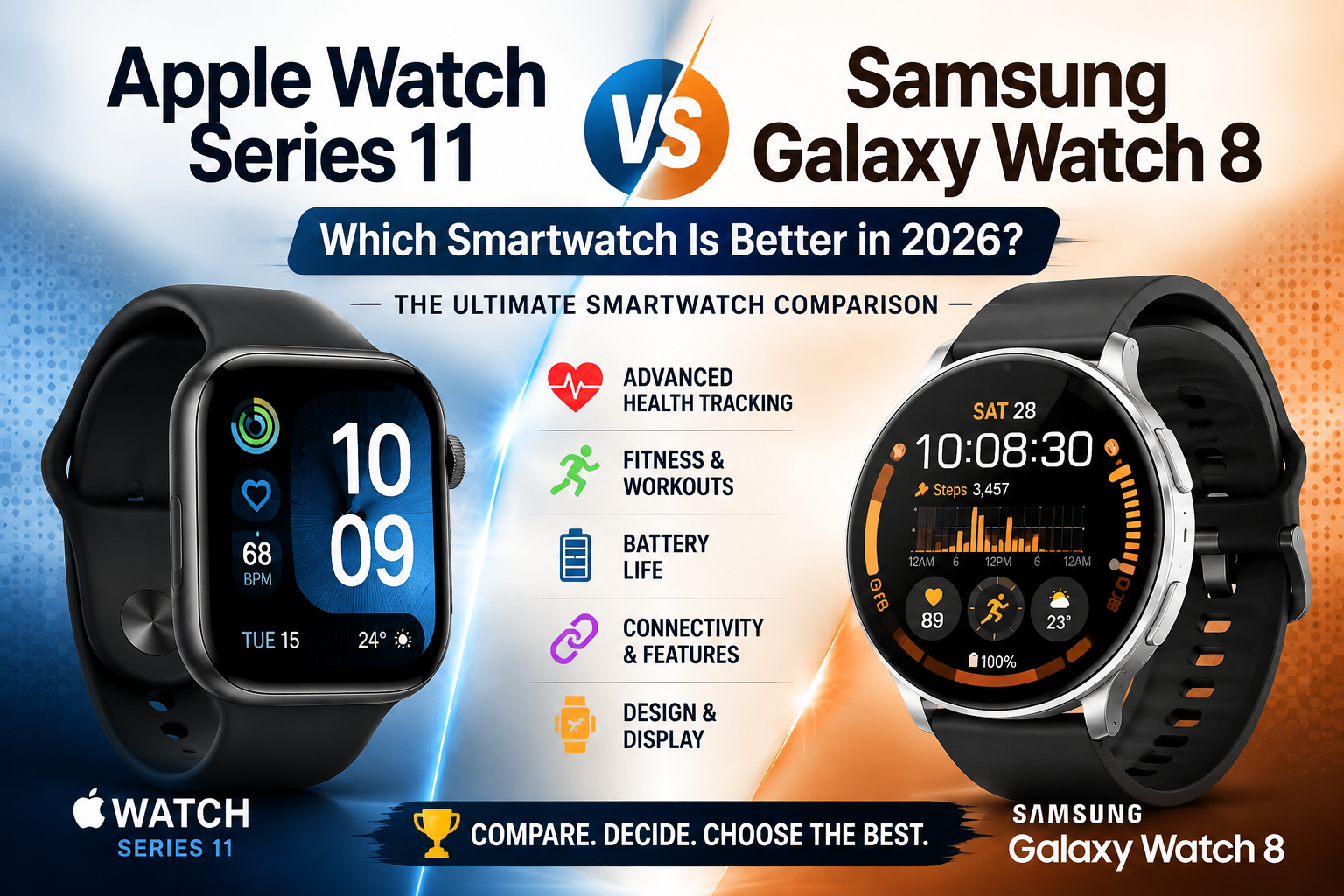
2. Apple Watch Cellular – Best for Apple Families
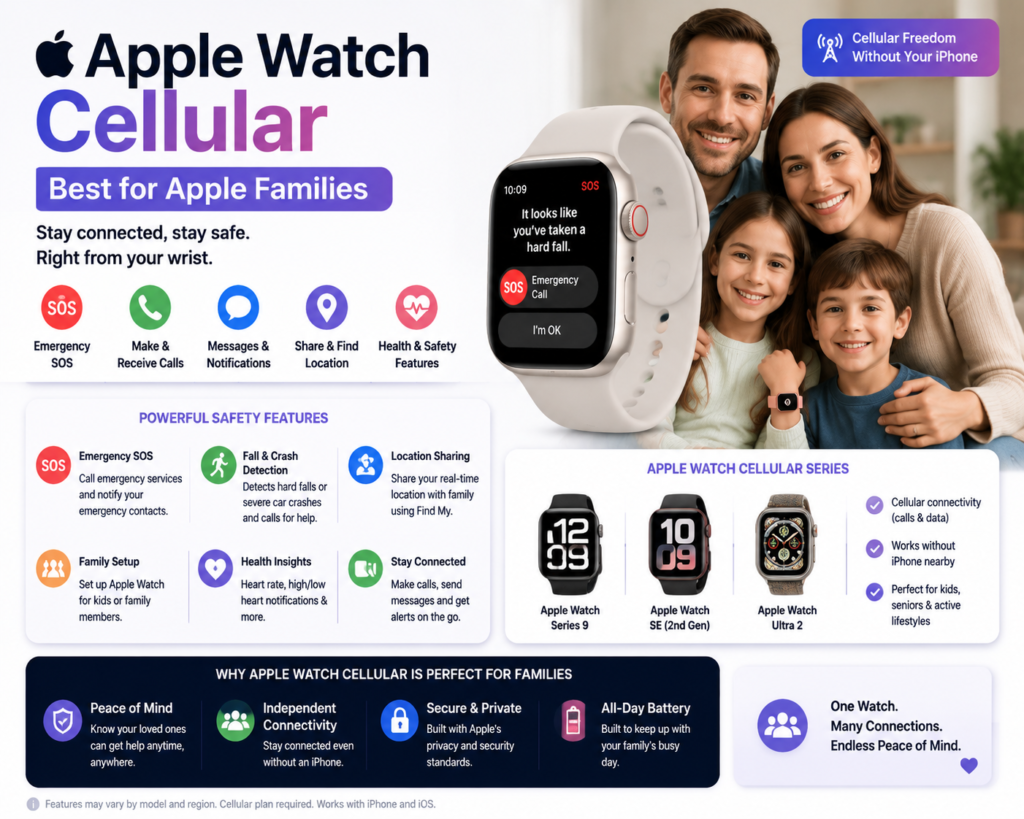
Apple Watch can be a powerful safety wearable for families already using the Apple ecosystem.
Apple supports setting up a cellular Apple Watch for a child or family member through its family setup system in supported countries and regions. Parents or guardians can manage settings, including Emergency SOS and emergency contacts.
Apple’s Emergency SOS can call local emergency services and share the user’s location when supported connectivity is available. After an emergency call, the watch can also notify emergency contacts with the user’s location.
Key safety features
- Emergency SOS
- Emergency contacts
- Cellular connectivity on supported models
- Location sharing
- Find My integration
- Fall Detection on supported models
- Crash Detection on supported models
- Family setup on supported devices and regions
Apple Family Sharing can also allow family members to share their locations through Find My.
Best for: Families already using iPhone and Apple services.
Our verdict: ⭐⭐⭐⭐⭐
Safety focus: Excellent
Best feature: Emergency SOS + Apple ecosystem integration
3. Samsung Galaxy Watch LTE – Strong Android Option
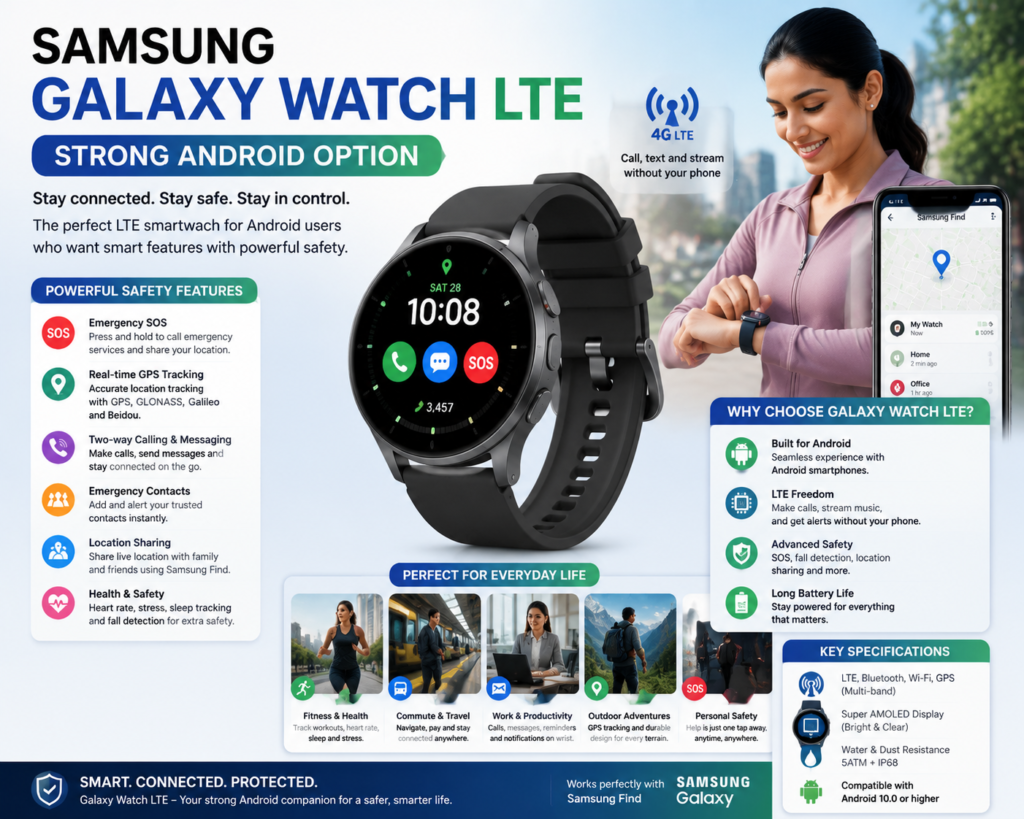
Samsung Galaxy Watch is another option for users who prefer Android and Samsung devices.
LTE-enabled Galaxy Watch models can provide cellular connectivity, while Samsung’s ecosystem includes location-sharing and device-finding functionality through Samsung Find. Samsung’s India support documentation specifically provides guidance for sharing location with friends, children, family and other contacts.
Key features to look for
- GPS
- LTE connectivity
- Emergency SOS
- Location sharing
- Emergency contacts
- Samsung Find
- Health and activity tracking
- Smartphone integration
Best for: Android users who want a full-featured smartwatch with safety capabilities.
Our verdict: ⭐⭐⭐⭐½
Safety focus: Very good
Best feature: Android ecosystem + LTE functionality
4. GPS Safety Bands – Best for Simple SOS Protection
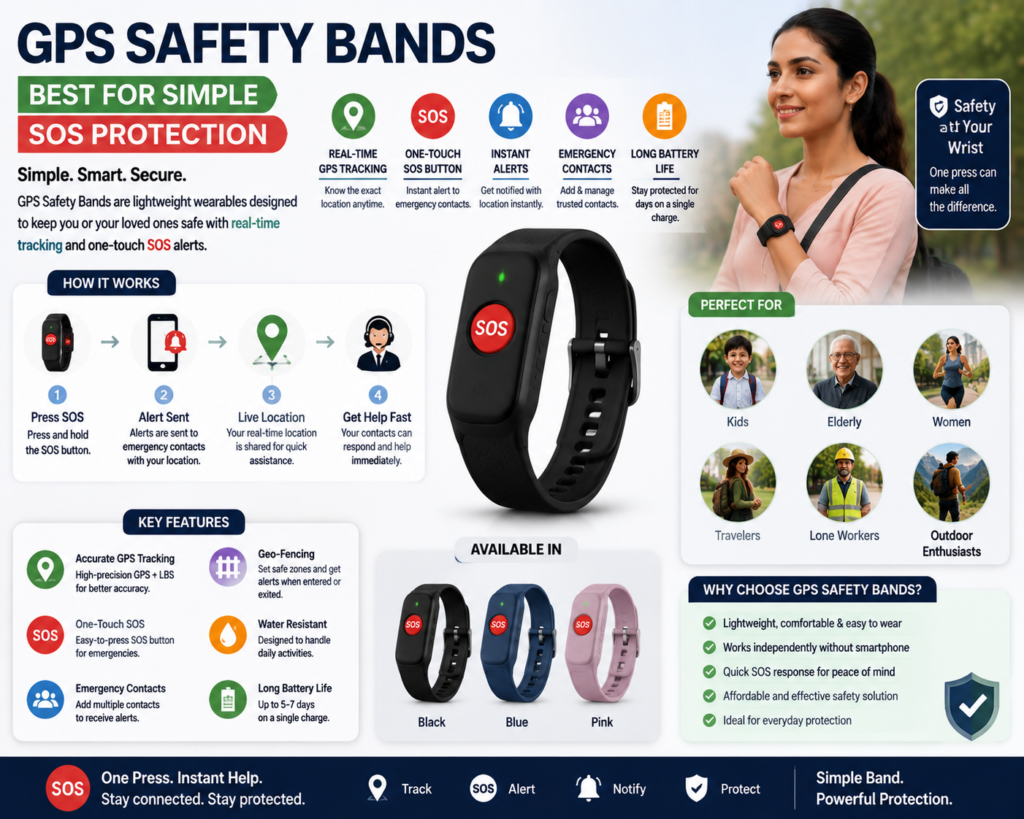
Dedicated GPS safety bands are becoming an interesting category for families and personal safety.
Instead of offering dozens of smartwatch functions, these devices generally focus on:
- GPS tracking
- One-touch SOS
- Emergency contacts
- Location sharing
- Geofencing
- Long battery life
- Lightweight construction
For example, the India-focused Kavach safety wearable currently describes a combination of real-time GPS tracking, one-touch SOS, geofencing and a claimed 72-hour battery life.
Best for: Users who prioritize safety functions over entertainment and smartwatch features.
Our verdict: ⭐⭐⭐⭐½
Safety focus: Excellent when the service/network is available
Best feature: Simple dedicated SOS operation
5. Discreet SOS Wearables for Women
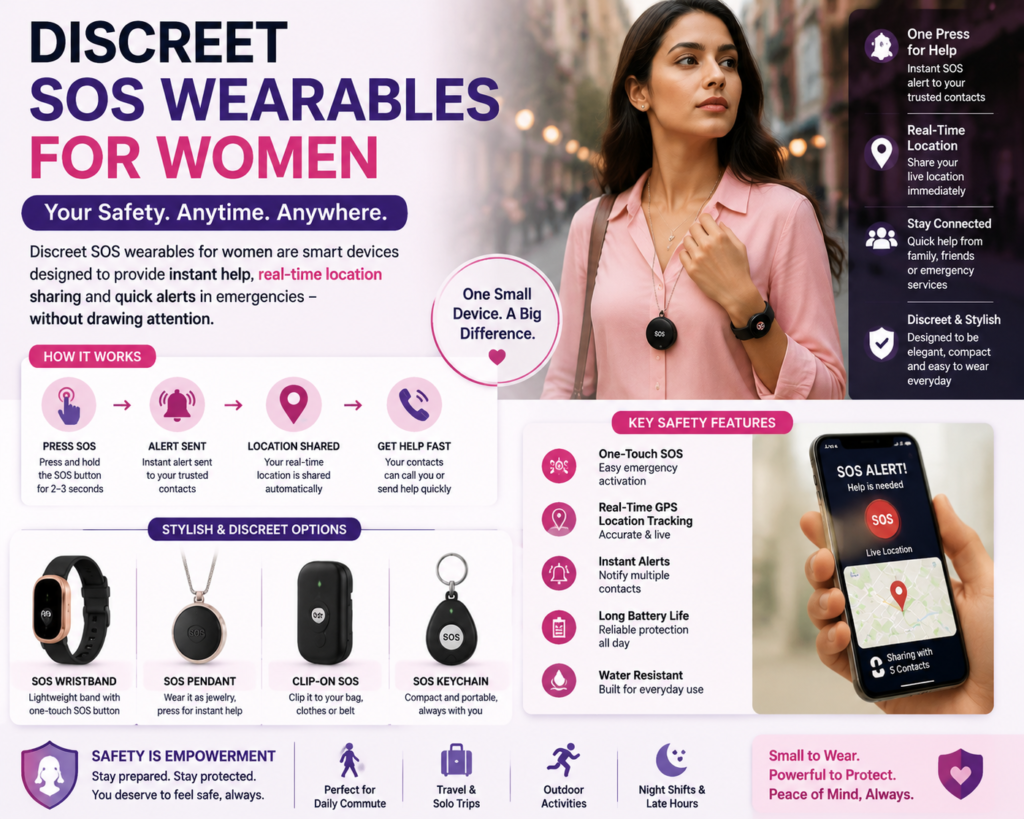
For women, the ideal wearable does not necessarily have to look like a traditional smartwatch.
A discreet wearable can be designed as:
- A wristband
- A small pendant
- A clip-on device
- A keychain-style wearable
- A compact personal safety device
The most important functions are easy SOS activation, location sharing and rapid communication with trusted contacts.
Emerging Indian safety-wearable systems such as Sakhi are exploring discreet wearable designs where pressing the device can trigger SOS, share location and activate additional response functions.
Best for: Women who want a small and discreet personal safety device.
Our verdict: ⭐⭐⭐⭐½
Safety focus: Excellent
Best feature: Discreet emergency activation
Key Features to Look for in GPS Safety Wearables
When choosing among the best GPS safety wearables for kids and women in 2026, look beyond the word “GPS.”
1. Real-Time GPS Tracking
Real-time tracking allows an authorized parent or trusted contact to see the wearer’s current or recently reported location.
For children, this can be useful during:
- School travel
- Tuition classes
- Outdoor activities
- Family trips
- Crowded events
Always check how frequently the device updates its location because “GPS tracking” does not necessarily mean continuous live tracking.
2. One-Touch SOS Button
The SOS button is arguably the most important safety feature.
A child or woman should be able to activate an alert quickly without navigating through multiple menus.
Ideally, an SOS function should:
- Detect the button press.
- Notify selected emergency contacts.
- Share the user’s location.
- Provide additional information where supported.
- Continue location updates when appropriate.
3. Geofencing
Geofencing allows parents or caregivers to define safe areas.
For example:
Home → School → Tuition Centre → Home
If the wearable detects that the child has entered or left a predefined area, the parent may receive an alert.
Garmin’s Bounce 2, for example, supports parent-defined areas and notifications when a child enters or leaves those areas.
4. Two-Way Calling
GPS alone cannot solve every safety situation.
If a child becomes lost, hearing a parent’s voice can be extremely useful. Two-way calling allows the child and parent to communicate directly through the wearable.
This is one reason dedicated cellular kids’ watches can be more useful than basic Bluetooth-only trackers.
5. Fall Detection
Fall detection can provide another layer of protection, particularly for older users or people participating in outdoor activities.
However, fall detection is not perfect. False positives and missed events are possible, so it should be considered an additional safety feature rather than a guaranteed emergency system.
6. Battery Life
A GPS wearable is useful only when it has sufficient battery power.
Look for:
- At least a full day of practical use
- Battery alerts
- Fast charging
- Low-power modes
- Clear charging indicators
GPS, LTE and frequent location updates can consume considerably more power than basic smartwatch functions.
GPS vs Cellular: What’s More Important?
This is one of the most important things to understand before buying.
GPS
GPS determines the device’s geographical position.
Cellular/LTE
Cellular connectivity allows the wearable to communicate that location to another device when the smartphone is not nearby.
Therefore:
GPS + Cellular = much more useful for standalone safety tracking.
A GPS-only wearable may know where it is but still require a nearby phone or another communication method to send that information.
This is why parents should check whether a kids’ tracker works independently or only when paired with a smartphone.
GPS Safety Wearables for Kids vs Women
The requirements are slightly different.
| Feature | Kids | Women |
|---|---|---|
| GPS tracking | Essential | Very useful |
| One-touch SOS | Essential | Essential |
| Geofencing | Very useful | Optional |
| Two-way calling | Very useful | Useful |
| Discreet design | Useful | Very important |
| Location history | Useful | Useful |
| Fall detection | Useful | Useful |
| Long battery life | Essential | Essential |
| Cellular/LTE | Highly recommended | Highly recommended |
| Parent controls | Essential | Not usually required |
| Emergency contacts | Essential | Essential |
How to Choose the Best GPS Safety Wearable for a Child
Before buying a kids’ GPS wearable, ask these questions:
Does it work without a smartphone?
If the child does not carry a phone, choose a cellular/LTE model or a dedicated tracker that supports independent communication.
Does it support geofencing?
This can be particularly useful for school and home routines.
Can parents control contacts?
A child-focused device should ideally restrict communication to approved contacts.
Does the device have an SOS button?
The button should be easy for a child to understand and operate.
How long does the battery last?
A watch that needs charging several times a day may be impractical.
Does the service work in your country?
This is especially important with LTE-based devices.
For example, Garmin’s published Bounce 2 LTE coverage list currently includes specific supported countries, and availability depends on network coverage and conditions. India is not listed in the current coverage table, so Indian buyers should verify compatibility before purchasing.
How to Choose the Best GPS Safety Wearable for Women
Women may have different priorities than children.
A good personal safety wearable should ideally offer:
- Fast SOS activation
- Discreet design
- GPS/location sharing
- Cellular connectivity
- Emergency contacts
- Long battery life
- Reliable app support
- Strong privacy controls
- Water and dust resistance
- Comfortable all-day wearing
For someone who travels frequently, a compact SOS wearable may be more practical than a large smartwatch.
For someone already using an iPhone or Android phone, a cellular smartwatch can combine everyday smartwatch features with emergency functions.
Privacy and Security Are Extremely Important
GPS tracking creates sensitive location data.
Before purchasing a wearable, check:
- Who can view the location?
- Is location history stored?
- Can family members be removed?
- Is data encrypted?
- Can location sharing be disabled?
- Does the manufacturer explain how data is handled?
- What happens if the device is lost?
- Can unknown people contact the wearer?
Parents should also explain to older children why location tracking is being used and establish clear rules about privacy.
The goal should be safety without unnecessary surveillance.
Are GPS Safety Wearables 100% Reliable?
No.
A GPS wearable should never be treated as a guaranteed emergency-response system.
Performance can be affected by:
- Weak cellular coverage
- Indoor environments
- Buildings
- Tunnels
- Battery depletion
- GPS signal limitations
- Network congestion
- Device damage
- Software problems
- Subscription issues
Manufacturers themselves emphasize these limitations. Garmin, for example, explicitly states that Bounce 2’s safety and tracking features are supplemental and that the Garmin Jr. app does not contact emergency services on behalf of the user.
Therefore, families should combine wearable technology with sensible safety practices.
Best GPS Safety Wearables for Kids & Women in 2026: Quick Comparison
| Wearable Type | GPS | SOS | Calling | Geofencing | Best For |
| Garmin Bounce 2 | Yes | Assistance | Yes | Yes | Kids |
| Apple Watch Cellular | Yes | Yes | Yes | Family/location features | Apple families |
| Samsung Galaxy Watch LTE | Yes | Yes* | Yes | Ecosystem dependent | Android users |
| Dedicated GPS Safety Band | Yes | Yes | Varies | Often | Kids & women |
| Discreet SOS Wearable | Usually | Yes | Varies | Varies | Women |
| Basic GPS Tracker | Yes | Varies | Usually no | Often | Simple tracking |
*Specific functions vary by model, software, region and connectivity.
7 Important Buying Tips Before You Purchase
1. Check Cellular Compatibility
Do not assume that every LTE smartwatch works with every network.
Check:
- Country availability
- Carrier compatibility
- eSIM/SIM requirements
- Subscription fees
- LTE bands
- Coverage in your area
2. Check the SOS Process
A complicated emergency process defeats the purpose of a safety wearable.
Prefer a physical button or simple activation mechanism.
3. Check Battery Performance
Look beyond the manufacturer’s maximum battery claim. Real-world GPS and cellular usage can reduce battery life.
4. Check the Companion App
The app is almost as important as the wearable itself.
Look for:
- Live location
- Location history
- Geofencing
- Battery status
- Contact management
- Alerts
- Multiple caregiver support
5. Check Privacy Controls
Only authorized people should have access to location information.
6. Check Water Resistance
Children may wear the device while playing outdoors, and women may use it during exercise or travel.
7. Check Subscription Costs
Some cellular safety wearables require monthly or annual subscriptions for GPS tracking, calling and SOS services.
The purchase price is therefore not necessarily the total cost of ownership.
Best Use Cases for GPS Safety Wearables
GPS safety wearables can be useful in many situations.
For children
- School commute
- Tuition travel
- Outdoor games
- Family vacations
- Crowded festivals
- Shopping malls
- Theme parks
- Cycling
- Walking to nearby locations
For women
- Daily commuting
- Solo travel
- Night shifts
- Walking or running
- Cab or public transport journeys
- Travel to unfamiliar locations
- Outdoor activities
- Emergency situations
Future of GPS Safety Wearables
The next generation of safety wearables is likely to combine GPS, cellular communication, AI, sensors and smarter emergency detection.
Potential developments include:
- AI-based risk detection
- Improved location accuracy
- Faster SOS response
- Better fall detection
- Longer battery life
- Satellite connectivity
- Smaller wearable designs
- Voice-activated emergency functions
- Automated incident recording
- More advanced geofencing
- Integration with smart-home and family safety platforms
Research and commercial development are also expanding around wearable-based safety technologies, including GPS, wireless communication and emergency-alert systems.
Frequently Asked Questions
What is the best GPS safety wearable for kids in 2026?
For a dedicated kids’ smartwatch, Garmin Bounce 2 is one of the notable options because it combines real-time location tracking, LTE communication, calling, messaging and parent-controlled location features. However, availability and LTE coverage should be checked in your country before purchasing.
What is the best GPS safety wearable for women?
The best choice depends on whether the priority is discreet SOS protection or a full smartwatch. A dedicated SOS band can be ideal for simple emergency protection, while a cellular Apple Watch or Galaxy Watch can provide a broader combination of communication, location and smartwatch features.
Do GPS trackers work without a phone?
Some do and some do not. Cellular GPS wearables can communicate independently when supported by a compatible network and subscription. Bluetooth-only trackers generally depend on another nearby device or network of devices.
Does GPS work indoors?
GPS performance can be weaker indoors. A wearable may rely on additional positioning technologies, Wi-Fi or cellular information to improve location estimates.
Are GPS safety wearables worth buying?
They can be worthwhile as an additional layer of safety, particularly for children travelling independently or people who need quick access to emergency contacts. However, they should not replace normal safety practices or emergency services.
Is an SOS smartwatch better than a normal GPS tracker?
It depends on the requirement. An SOS smartwatch may provide calling, messaging, GPS, health tracking and emergency functions, while a dedicated GPS tracker can be simpler and potentially easier to operate.
Do GPS safety wearables require a subscription?
Some do, especially cellular devices that provide independent calling, messaging, live tracking and SOS communication. Always check the recurring cost before buying.
Final Verdict
The best GPS safety wearables for kids and women in 2026 are not necessarily the devices with the most features. The best option is the one that provides reliable location information, simple SOS activation, appropriate communication features, adequate battery life and dependable connectivity for the user’s situation.
For children, a dedicated GPS smartwatch with parent controls, geofencing, calling and location tracking can provide a useful safety layer without giving them a full smartphone.
For women, a discreet SOS wearable or cellular smartwatch can provide quick access to emergency contacts and location sharing while remaining useful for everyday activities.
Most importantly, always check network compatibility, subscription requirements, emergency-service availability, privacy policies and local support before purchasing.
Technology can improve personal safety, but it should work alongside awareness, communication and a practical emergency plan—not replace them.
In 2026, the smartest safety wearable is not simply the one that tracks location. It is the one that helps the right people connect quickly when it matters most.

One thought on “Best GPS Safety Wearables for Kids & Women in 2026: Smart Tracking, SOS & Emergency Features”