


Introduction
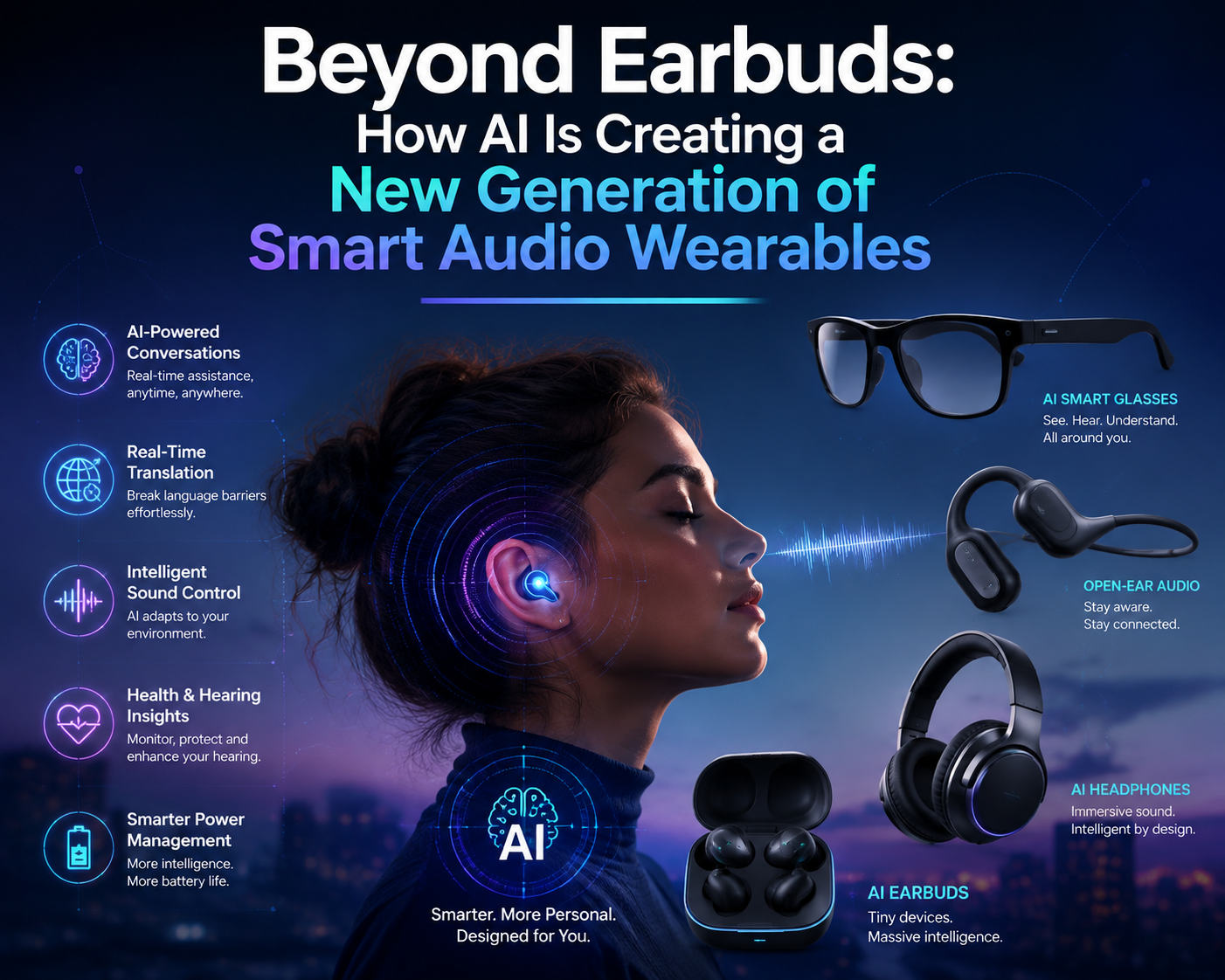
AI is creating a new generation of smart audio wearables that are transforming the way we experience personal audio technology in 2026. These advanced devices are no longer limited to playing music or managing phone calls; they are evolving into intelligent digital companions powered by artificial intelligence, advanced sensors, machine learning, voice recognition, and real-time processing capabilities.
For many years, wireless earbuds and headphones were considered simple audio accessories designed mainly for entertainment and communication. Their primary functions included music playback, phone calls, active noise cancellation, and basic voice assistant support. However, rapid advancements in artificial intelligence are changing the role of audio devices from passive listening tools into intelligent and interactive technology platforms.
Today, AI smart audio wearables are becoming one of the most innovative categories in wearable technology. Unlike traditional earbuds, these next-generation devices can understand human conversations, analyze surrounding environments, adapt sound based on user preferences, and provide personalized assistance in real time.
The evolution of AI-powered audio wearables is creating a completely new approach to listening experiences. By combining artificial intelligence with microphones, sensors, edge computing, and advanced connectivity, smart audio devices can recognize important sounds, improve communication, support productivity, and deliver smarter interactions throughout the day.
Modern smart audio wearables with AI technology are designed to go beyond sound delivery. They can function as personal AI assistants by offering features such as real-time language translation, AI-powered conversations, adaptive noise control, personalized audio profiles, voice commands, and intelligent hearing support. These capabilities are making earbuds, headphones, and hearable devices more useful in everyday life.
This transformation does not mean traditional audio devices are becoming outdated. Instead, they are becoming smarter and more capable. The future of audio technology is shifting from simply listening to understanding, where devices can recognize user needs, respond naturally, and provide meaningful assistance at the right moment.
The rise of AI-enabled hearables represents a significant milestone in wearable technology. These intelligent devices combine voice computing, environmental awareness, health-focused features, and personalized digital experiences to create a more connected relationship between humans and technology.
The Rise of AI Smart Audio Wearables in 2026
The growth of AI smart audio wearables in 2026 shows how artificial intelligence is reshaping the wearable technology industry. Unlike conventional earbuds and headphones that mainly focus on sound quality, modern AI-powered devices are designed to learn user behavior, adapt to different environments, and provide intelligent support with minimal smartphone interaction.
From AI earbuds and smart headphones to AI-powered smart glasses, this new generation of audio wearables is changing how people communicate, work, travel, study, and enjoy entertainment. These devices are becoming more aware of their surroundings and capable of delivering personalized experiences based on individual needs.
The future of audio is no longer only about better sound quality, stronger bass, or improved noise cancellation. Instead, it is moving toward intelligent devices that understand users, predict their requirements, and provide assistance whenever it is needed.
As artificial intelligence continues to advance, AI is creating a new generation of smart audio wearables that combine the power of AI, wearable computing, and human-centered design. These innovations are expected to play an important role in the future of personal technology by making everyday interactions more natural, intelligent, and connected.
Table of Contents
What Are Smart Audio Wearables?
Smart audio wearables are wearable devices that combine audio hardware with sensors, connectivity and software intelligence.
They can include:
- AI-powered earbuds
- Open-ear headphones
- Smart glasses with built-in speakers
- Hearing-focused hearables
- AI-enabled headphones
- Audio-enabled wearable assistants
- Future ear-worn devices with biometric sensors
The important distinction is intelligence.
A conventional wireless earbud primarily waits for a command from the user. An AI-enabled audio wearable can increasingly analyze information and respond according to the situation.
For example, instead of simply translating a sentence after being asked, a future device could recognize that two people are speaking different languages and offer translation assistance when appropriate.
That shift—from audio playback to contextual assistance—is one of the most important developments in wearable technology in 2026.
Why AI Is Changing Audio Wearables
AI is particularly suitable for wearable audio because microphones and speakers already provide a natural communication interface.
A user does not necessarily need to look at a screen.
They can simply speak.
This creates a more natural interaction model:
Hear → Understand → Process → Respond
Modern AI systems can combine speech recognition, language models, noise processing and contextual information to make this interaction more useful.
Qualcomm’s 2026 vision for personal AI similarly describes an ecosystem in which AI can operate across devices and wearable form factors, with increasing emphasis on efficient on-device intelligence.
1. AI Earbuds Are Becoming Personal Assistants
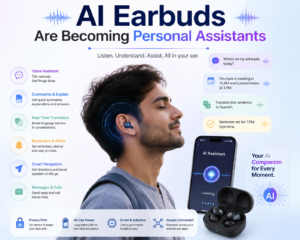
One of the biggest changes is the transformation of earbuds from passive audio devices into voice-driven assistants.
Instead of opening a smartphone, users could potentially ask their earbuds to:
- Summarize information
- Set reminders
- Answer general questions
- Translate speech
- Draft or dictate messages
- Explain something they hear
- Provide directions
- Manage selected phone functions
- Help during conversations
The key advantage is convenience.
The user can keep their phone in their pocket while interacting with an AI system through voice.
This could be particularly useful while walking, commuting, exercising or working.
However, AI assistants in earbuds still depend heavily on microphones, connectivity, battery capacity, processing power and software quality. Therefore, the experience will vary between devices.
Modern AI earbuds are evolving into intelligent personal assistants that can help users manage tasks without constantly checking their smartphones. With advanced voice recognition and AI processing, smart earbuds with AI technology can support real-time conversations, reminders, translations, navigation assistance, and information access. This transformation is changing earbuds from simple audio accessories into connected AI companions.
2. On-Device AI Could Make Audio Wearables Faster and More Private
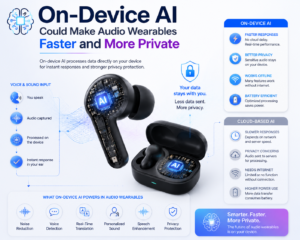
Cloud-based AI is powerful, but sending every voice interaction to a remote server can create latency, connectivity and privacy concerns.
This is where on-device AI becomes important.
Modern wearable processors are increasingly incorporating dedicated AI acceleration. Qualcomm’s Snapdragon Wear Elite platform, for example, includes an integrated Hexagon NPU designed for on-device AI processing and supports models with billions of parameters.
For audio wearables, local processing could help with tasks such as:
- Noise classification
- Wake-word detection
- Speech enhancement
- Voice isolation
- Basic translation functions
- Personalized sound processing
- Sensor interpretation
The benefit is not simply speed.
Keeping more processing on the device can potentially reduce the amount of personal audio data that needs to leave the wearable.
That matters because microphones can capture conversations and environmental sounds that involve people other than the wearer.
One of the biggest improvements in AI smart audio wearables 2026 is the growth of on-device AI processing. By processing certain tasks directly inside the wearable device, AI-powered earbuds can provide faster responses, improved privacy, and reduced dependency on cloud servers. This approach allows users to experience intelligent features such as noise reduction, speech enhancement, and personalized audio while keeping more data secure.
3. Noise Cancellation Is Moving Toward Intelligent Sound Management
Active Noise Cancellation, or ANC, is already common in premium earbuds.
But AI can make noise management more adaptive.
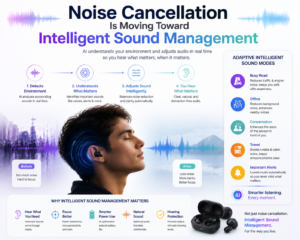
Instead of simply choosing between ANC and transparency modes, an intelligent wearable could identify different sound environments.
For example:
Busy road: Reduce distracting traffic noise.
Office: Reduce air-conditioning and background noise while preserving nearby speech.
Conversation: Prioritize the voice of the person standing in front of you.
Public announcement: Temporarily reduce music volume and increase important environmental audio.
This represents a change from noise cancellation to sound prioritization.
The objective is no longer simply to make everything quieter.
The objective is to help the user hear the right sound at the right time.
4. AI Could Make Conversations Easier to Understand

Speech recognition is becoming one of the most interesting applications for AI wearables.
Imagine attending a meeting in a noisy environment.
Instead of trying to hear every speaker perfectly, an intelligent audio wearable could potentially:
- Identify speech.
- Separate voices from background noise.
- Convert speech into text.
- Identify important points.
- Create a summary.
- Allow the user to retrieve information later.
Current research shows that this remains technically challenging, particularly when several people speak simultaneously. A 2026 smart-glasses speech benchmark specifically highlights speaker overlap and complex acoustic environments as major difficulties for AI systems.
Therefore, this is an exciting direction—but not a solved problem.
5. Real-Time Translation Could Become More Natural
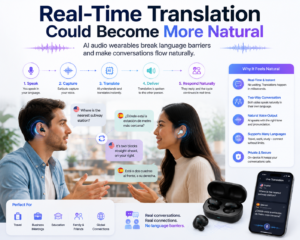
Language translation is another area where AI smart audio wearables could have a major impact.
Traditional translation usually requires looking at a phone.
AI wearables can potentially make the process more conversational.
A person speaks in one language.
The wearable processes the speech.
The translated response is delivered through the user’s audio device.
This could be useful for:
- International travel
- Business meetings
- Tourism
- Customer service
- Education
- Multilingual families
- Cross-language conversations
Smart glasses are particularly interesting because they can combine audio with visual information. Current 2026 smart-glasses products already demonstrate features such as live translation and AI-assisted interaction.
The long-term goal is not merely translation software.
It is translation that feels like part of the conversation.
Real-time language support is expected to become a major feature of future AI audio wearables. AI translation earbuds could help users communicate across different languages by capturing speech, translating conversations instantly, and delivering natural voice responses. This technology may become valuable for travelers, international business users, students, and multilingual communities.
6. Hearing Health Is Becoming a Major Wearable Category
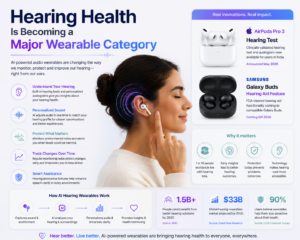
Perhaps one of the most meaningful developments is the growing connection between audio wearables and hearing health.
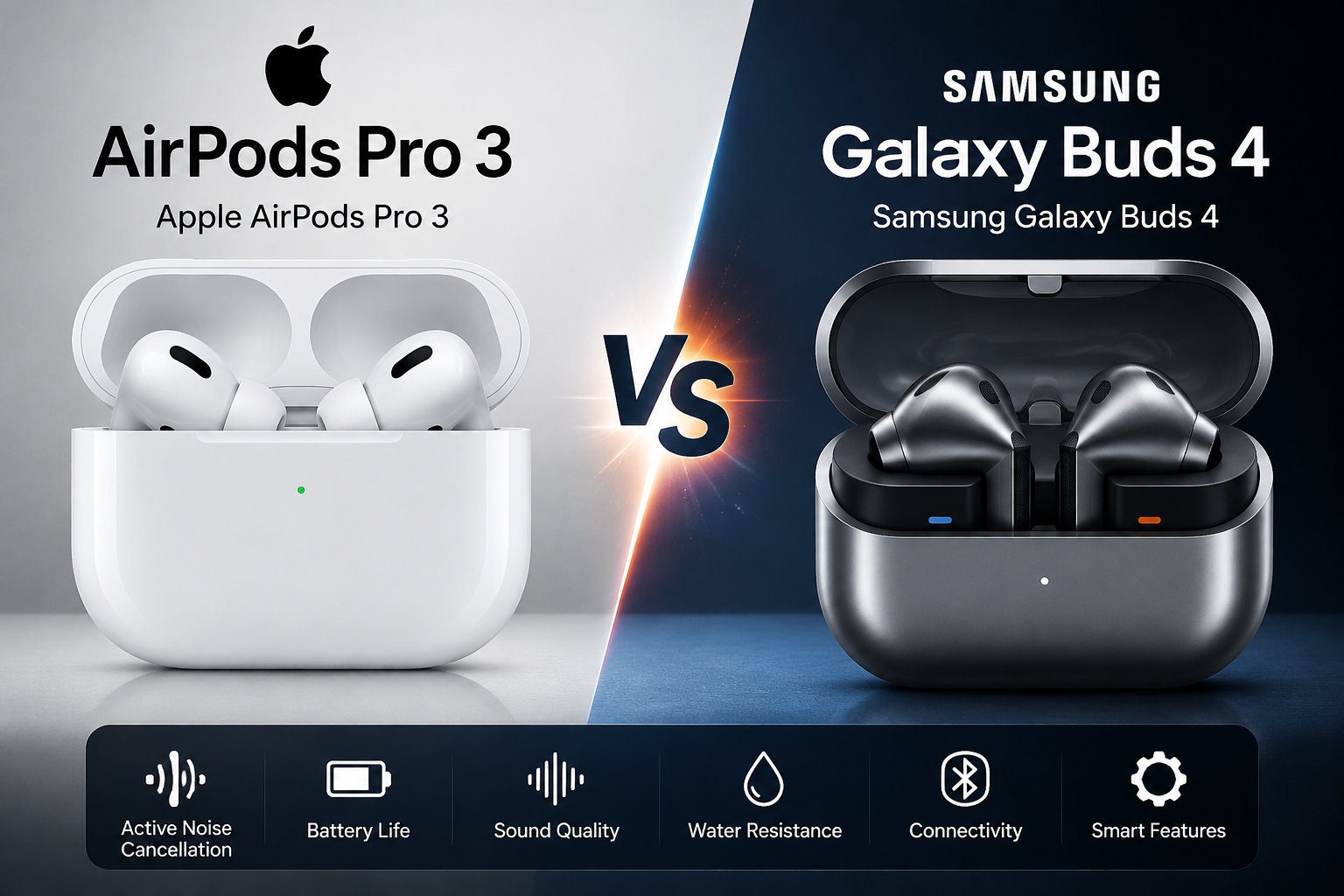
In May 2026, Apple announced that AirPods Pro 3 users in India could access a clinically validated Hearing Test that produces information about hearing levels and an audiogram.
Samsung has also announced FDA-cleared hearing-aid functionality for compatible Galaxy Buds, with availability planned for Q4 2026 in the United States and selected markets.
These developments demonstrate that audio wearables are moving beyond entertainment.
Future devices could increasingly help users:
- Understand their hearing profile
- Personalize sound amplification
- Monitor environmental noise exposure
- Improve speech clarity
- Detect changes that deserve professional attention
- Protect hearing through safer listening recommendations
However, consumers should not automatically treat a wearable’s health feature as a replacement for professional medical evaluation.
Beyond entertainment, AI hearing technology is expanding the role of audio wearables in health and accessibility. Future smart earbuds with AI may provide hearing assessments, personalized audio adjustments, noise exposure monitoring, and improved speech clarity. These developments show how wearable technology is moving beyond convenience toward personal wellness support.
7. Personalized Audio Could Become Much More Sophisticated
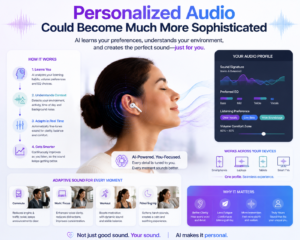
Everyone hears differently.
People also have different preferences for bass, vocals, volume, noise reduction and transparency.
AI can potentially learn these preferences.
For example, an intelligent audio system could gradually understand that a particular user prefers:
- Stronger speech clarity
- Lower bass
- More environmental awareness outdoors
- Different ANC levels while travelling
- Higher voice enhancement during meetings
Instead of asking users to manually adjust dozens of settings, AI could learn from usage patterns.
This could lead to a new concept:
Adaptive personal sound.
The device does not simply reproduce audio.
It creates an audio experience that changes according to the individual and the environment.
The future of smart audio technology will focus on personalized experiences. AI algorithms can analyze listening habits, environmental conditions, and user preferences to create customized sound profiles. These intelligent audio devices can automatically adjust equalizer settings, noise control levels, and sound clarity to match different situations such as travel, work, exercise, and relaxation.
8. Smart Glasses Are Expanding the Definition of Audio Wearables
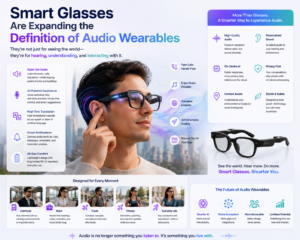
The future of smart audio is not limited to devices placed inside the ear.
Smart glasses are becoming an important part of the same ecosystem.
A pair of AI glasses can combine:
Microphones + speakers + AI + cameras or sensors + connectivity
This gives the user another hands-free interface.
For example, smart glasses can potentially provide:
- Voice-based AI assistance
- Navigation instructions
- Translation
- Reminders
- Conversation support
- Environmental information
- Audio notifications
- Hands-free communication
Some 2026 smart-glasses designs are even experimenting with camera-free approaches that focus on audio, microphones and AI while attempting to address privacy concerns.
This is important because the future of wearable computing may involve several devices working together rather than one product doing everything.
9. AI Audio Wearables Could Become Part of a Personal AI Ecosystem
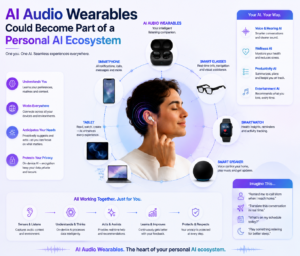
The smartphone may remain the central computing device, but wearables can become additional interfaces.
Consider a possible future setup:
Smartphone: Main computing and connectivity hub
Earbuds: Hearing, communication and voice interaction
Smartwatch: Health and activity sensing
Smart glasses: Visual information and hands-free AI
Cloud AI: Advanced processing and long-term intelligence
This creates a connected personal technology environment.
Instead of constantly reaching for a smartphone, users could interact with different devices depending on the situation.
This concept aligns with the broader industry movement toward an interconnected personal-AI ecosystem.
10. The Charging Case Could Become Smarter Too
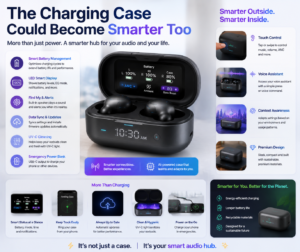
An overlooked part of the earbud experience is the charging case.
Future charging cases could potentially become small computing and connectivity accessories rather than simple batteries.
Possible capabilities include:
- Battery optimization
- Device diagnostics
- Firmware management
- Audio-profile storage
- Additional microphones
- Connectivity assistance
- Emergency functions
- Small displays or controls
The case could effectively become the bridge between the earbuds and the user’s wider digital ecosystem.
11. AI Could Help Users Listen More Safely
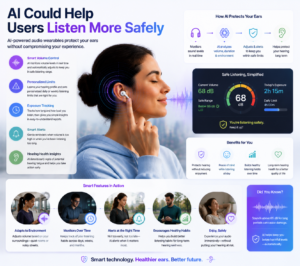
More intelligence does not necessarily mean louder or more immersive audio.
It could also mean safer listening.
Research on personal listening-device use highlights the importance of realistic usage patterns and safe-listening interventions as ear-worn technology evolves.
An intelligent wearable could potentially:
- Monitor listening exposure
- Warn when volume remains high for too long
- Recommend lower volume
- Adjust output based on environmental noise
- Encourage listening breaks
This could turn earbuds into tools that help users develop healthier listening habits.
12. Privacy Will Become One of the Biggest Issues

The more intelligent an audio wearable becomes, the more sensitive information it may encounter.
A microphone could hear:
- Conversations
- Names
- Business discussions
- Phone calls
- Public announcements
- Family conversations
- Background speech
This creates an important question:
Who controls the information captured by the device?
Privacy concerns are already growing around AI-enabled glasses and recording-capable wearables. Recent discussions have focused on consent, bystander privacy and the possibility of devices recording people without their knowledge.
Therefore, future AI smart audio wearables should ideally provide clear controls for:
- Microphone access
- Recording status
- Cloud processing
- Data storage
- Data deletion
- AI personalization
- Third-party access
Privacy should not be treated as an optional feature.
It should be part of the product design.
13. Battery Life Remains a Major Challenge
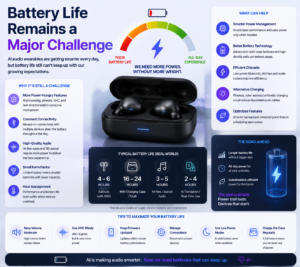
AI processing consumes energy.
Earbuds have extremely small batteries.
That creates a difficult engineering balance.
Manufacturers need to provide:
More intelligence + longer battery life + smaller hardware
at the same time.
This is one reason efficient AI accelerators and low-power processing are important.
The future will likely involve a combination of:
- On-device AI for lightweight tasks
- Cloud AI for demanding workloads
- Efficient AI models
- Better processors
- Smarter power management
- Improved battery technology
The best wearable may not be the one with the biggest AI model.
It may be the one that delivers the most useful intelligence without constantly requiring a recharge.
14. Audio Wearables Will Need Better Context Awareness
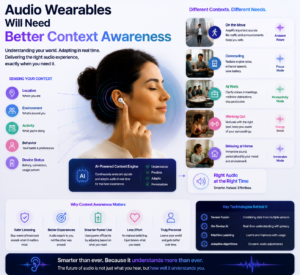
AI becomes much more useful when it understands context.
Consider the difference between these two commands:
“Remind me about this.”
Without context, that sentence is vague.
But if the wearable knows the user is in a meeting and has just heard a particular topic, the meaning becomes clearer.
Context could come from:
- Time
- Location
- Calendar
- Recent conversations
- Phone activity
- Movement
- Environmental sound
- Other connected wearables
However, context awareness must be carefully controlled because collecting more context also creates greater privacy responsibility.
15. What Could AI Smart Audio Wearables Look Like by 2030?
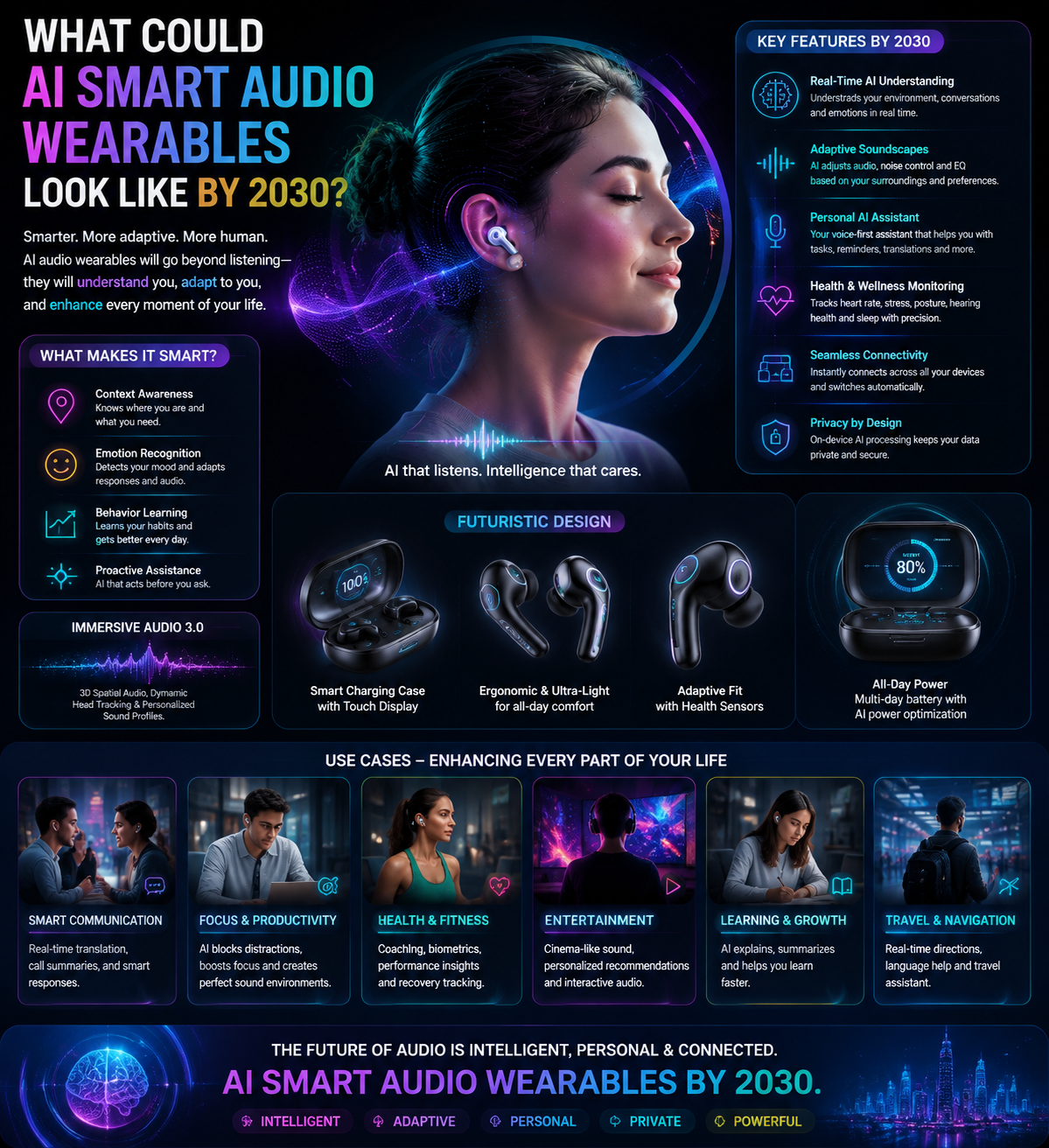
The next few years could bring significant changes.
Future devices may become:
Smaller
AI components and sensors may become more power-efficient, allowing more capability in smaller hardware.
More conversational
Users may communicate with their devices using natural speech rather than rigid voice commands.
More context-aware
The wearable could understand the situation before deciding whether assistance is necessary.
More health-focused
Audio devices may increasingly combine hearing assistance, environmental monitoring and other biometric functions.
More multimodal
Earbuds, watches, phones and glasses could work together to combine audio, visual and sensor information.
Less dependent on screens
Some tasks that currently require opening a smartphone may eventually be handled through voice and wearable interfaces.
The Biggest Difference: From Device to Companion
The most important change in AI smart audio wearables is not a particular feature.
It is the change in relationship between the user and the device.
Traditional earbuds are tools.
You choose what to listen to.
You press play.
You answer a call.
You activate ANC.
AI-enabled wearables can potentially become more proactive.
They may understand:
What you hear.
What you say.
What you need.
What is happening around you.
That could make them feel less like accessories and more like personal computing companions.
But this future will only succeed if convenience is balanced with privacy, accuracy, battery life, transparency and user control.
Who Can Benefit Most From AI Audio Wearables?
Different users can benefit in different ways.
| User | Potential Benefit |
|---|---|
| Students | Voice notes, explanations, translation and study assistance |
| Professionals | Meeting assistance, transcription and hands-free communication |
| Travelers | Translation and navigation |
| Content creators | Voice interaction and hands-free recording workflows |
| Fitness users | Audio guidance and environmental awareness |
| Older adults | Hearing assistance and easier voice interaction |
| Commuters | Noise management and hands-free information |
| Multilingual users | Real-time language assistance |
| Accessibility users | Speech enhancement and personalized audio |
The value will depend on how accurately each device performs these tasks and which features are available in the user’s region.
What Should You Look for When Buying an AI Audio Wearable in 2026?
Don’t buy a device simply because its packaging says “AI.”
Instead, evaluate the actual experience.
1. AI capabilities
Check exactly what the AI can do.
Is it limited to voice commands, or does it offer useful contextual features?
2. On-device processing
Look for information about which functions can operate locally.
This can matter for responsiveness, connectivity and privacy.
3. Microphone quality
AI cannot understand speech properly if the microphone system performs poorly in noisy environments.
4. Noise management
Look beyond the ANC number.
Evaluate how naturally the device handles voices and environmental sounds.
5. Battery life
Consider both the earbuds and charging case.
AI functions can affect real-world endurance.
6. Ecosystem compatibility
Some advanced features may require a particular smartphone, operating system or companion application.
7. Privacy controls
Check whether you can control recording, microphone access, cloud processing and stored data.
8. Health features
If hearing-related functions are important, check whether they are officially available in your country and understand their limitations.
9. Comfort
A technologically advanced device is not useful if you cannot comfortably wear it for extended periods.
10. Software support
AI features can improve through updates, so long-term software support may become as important as the hardware itself.
AI Smart Audio Wearables vs Traditional Earbuds
| Feature | Traditional Earbuds | AI Smart Audio Wearables |
|---|---|---|
| Music playback | Excellent | Excellent |
| Calls | Standard | AI-enhanced potential |
| ANC | Common in premium models | More adaptive potential |
| Voice assistant | Basic | More conversational |
| Translation | Usually phone-dependent | Increasingly integrated |
| Personalization | Manual | AI-assisted |
| Hearing features | Limited | Growing rapidly |
| Context awareness | Low | Increasing |
| Health integration | Limited | Expanding |
| On-device AI | Limited | Becoming more important |
| Privacy considerations | Moderate | Significantly higher |
The distinction is becoming less about whether a product is an “earbud” and more about how intelligently it interacts with the user.
Challenges That Could Slow the Revolution
Despite the excitement, AI audio wearables still have significant limitations.
Accuracy
AI can misunderstand speech, especially in noisy environments or group conversations.
Battery life
Continuous sensing and AI processing require energy.
Privacy
Always-available microphones create legitimate concerns about recording and data handling.
Cost
Advanced processors, sensors and AI services can increase the price.
Subscriptions
Some AI features may depend on paid services, which can increase the long-term ownership cost.
Social acceptance
People may feel uncomfortable around devices that appear capable of recording conversations.
Network dependence
Cloud-based AI can become less useful when connectivity is poor.
Regional availability
Some AI and health features may initially launch only in selected countries.
These limitations are important because the best technology is not necessarily the technology with the most features.
It is the technology that works reliably in everyday situations.
The Future Is Not “Earbuds vs Smart Glasses”
It may be tempting to predict that smart glasses will replace earbuds.
That is probably too simplistic.
The more likely scenario is cooperation.
For example:
Smart glasses could handle visual information.
Earbuds or open-ear speakers could handle private or ambient audio.
Smartwatches could monitor health and movement.
Smartphones could provide connectivity and computing.
AI systems could coordinate everything.
The result could be a distributed personal-computing system that follows the user throughout the day.
Why AI Smart Audio Wearables Matter in the Future
The future of AI smart audio wearables is not only about better sound quality. It is about creating intelligent devices that understand users, adapt to environments, and provide meaningful assistance at the right moment. From AI earbuds and smart headphones to audio-enabled smart glasses, these technologies represent a major shift toward more natural and personalized human-computer interaction.
As artificial intelligence continues to improve, next-generation audio wearables could become essential digital companions that support communication, productivity, entertainment, accessibility, and everyday decision-making.
Final Verdict: Are AI Audio Wearables the Next Big Wearable Category?
AI smart audio wearables are becoming much more than upgraded earbuds.
The technology is moving toward a world where wearable audio can assist with communication, translation, hearing, personalization, productivity and contextual interaction.
The most interesting development is not simply better sound quality.
It is the possibility of creating devices that understand the environment and respond intelligently without requiring the user to constantly look at a screen.
At the same time, the industry has important responsibilities. Privacy, consent, data security, accuracy, battery efficiency and transparent AI controls will determine whether people truly trust these products.
The 2026 generation therefore represents an important transition:
From earbuds that play what you choose → to wearables that can understand what is happening around you.
The future of personal audio may not be about listening to more technology.
It may be about technology understanding more of what we hear.
Frequently Asked Questions
What are AI smart audio wearables?
AI smart audio wearables are audio-focused wearable devices that combine microphones, speakers, sensors, connectivity and artificial intelligence to provide functions beyond traditional music playback and phone calls.
Are AI earbuds replacing smartphones?
Not yet. Smartphones remain important for computing, applications, connectivity and larger-screen tasks. AI audio wearables are better understood as additional interfaces that can make selected tasks hands-free.
Can AI earbuds translate conversations?
Some modern AI ecosystems offer translation-related capabilities, while future devices are expected to make conversational translation more natural. Availability and supported languages vary by product and region.
Can AI earbuds help with hearing?
Some advanced audio wearables now include hearing-related functions. For example, Apple has introduced a Hearing Test feature for AirPods Pro 3 in India, while Samsung has announced hearing-aid functionality for compatible Galaxy Buds in selected markets.
Is on-device AI better than cloud AI?
Neither is universally better. On-device AI can offer lower latency and reduce the need to send certain information to cloud servers, while cloud AI can provide access to more computationally demanding models.
Are AI audio wearables safe for privacy?
They can be designed with strong privacy protections, but users should carefully review microphone, recording, cloud-processing and data-retention controls. Devices capable of sensing conversations create privacy considerations for both users and people nearby.
Will AI audio wearables replace earbuds?
Rather than completely replacing earbuds, AI is likely to change what earbuds and other audio wearables can do. Music and calls will remain important, while AI assistance, health features and contextual interaction become additional capabilities.
Key Takeaway
The next generation of audio wearables is being built around a simple idea: audio should become an intelligent interface, not just an output channel.
As AI processing becomes smaller, faster and more power-efficient, earbuds, headphones and smart glasses could become increasingly useful personal assistants.
For consumers, the most important question in 2026 is no longer simply:
“Which earbuds have the best sound?”
It is increasingly:
“Which audio wearable can intelligently improve the way I communicate, listen and interact with the world—while respecting my privacy?”

2 thoughts on “Beyond Earbuds: How AI Is Creating a New Generation of Smart Audio Wearables in 2026”