


Introduction
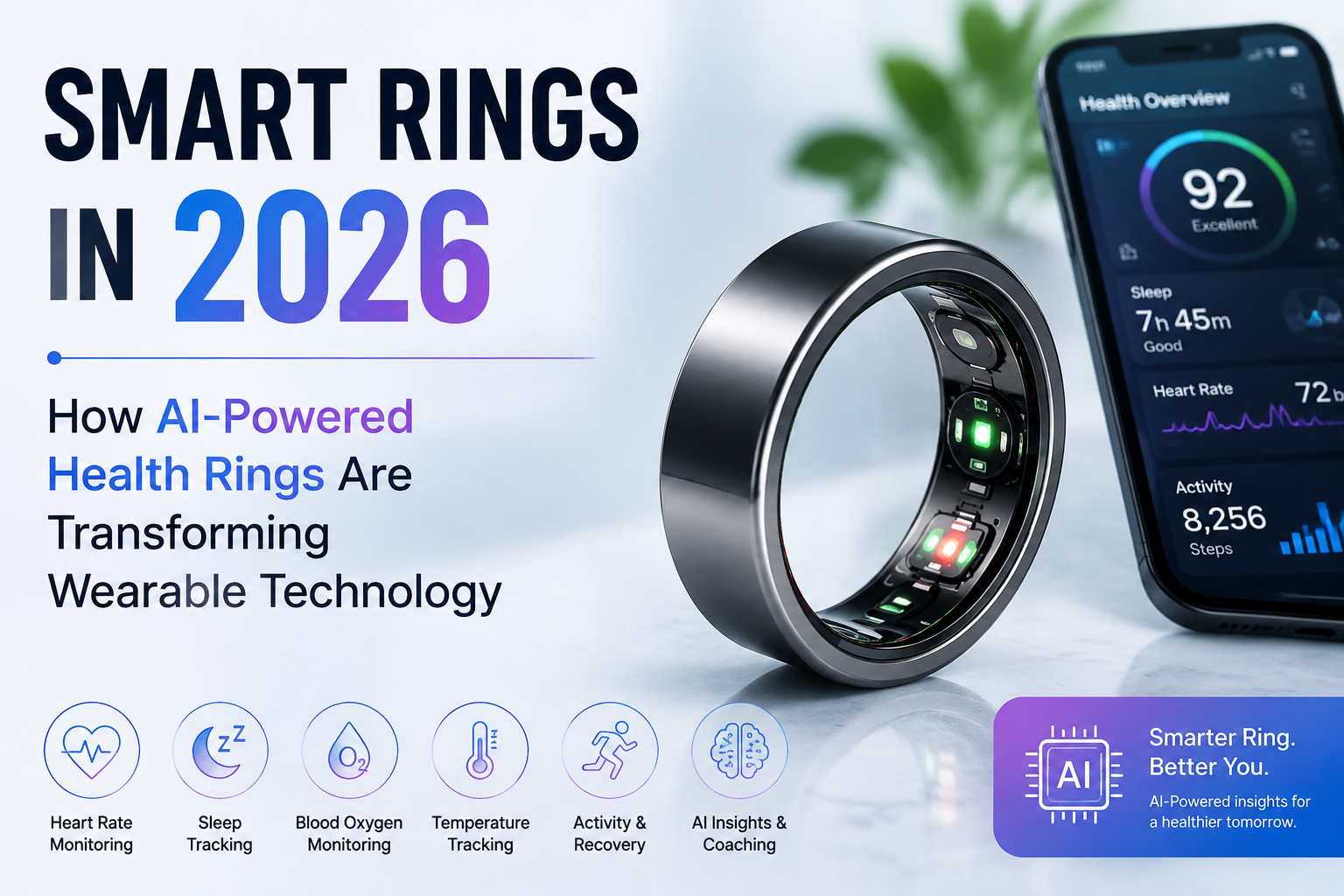
Smart Rings in 2026 are expected to become one of the most advanced developments in wearable technology, combining artificial intelligence, health monitoring, and personalized insights into a compact and comfortable ring design. Unlike traditional smartwatches, smart rings focus on continuous health tracking while offering a lightweight experience.
The growing popularity of Smart Rings in 2026 is driven by advanced sensors, AI-powered analysis, improved battery efficiency, and accurate biometric monitoring. These next-generation wearable devices can track sleep quality, heart rate, activity levels, recovery patterns, and overall wellness.
Modern smart rings are moving beyond basic fitness tracking. With artificial intelligence, connected ecosystems, and personalized recommendations, they are becoming smarter health companions for users who want deeper insights into their daily lifestyle.
In this article, we explore Smart Rings in 2026, including their AI features, health benefits, limitations, major brands, comparison with smartwatches, and how they could shape the future of wearable technology.
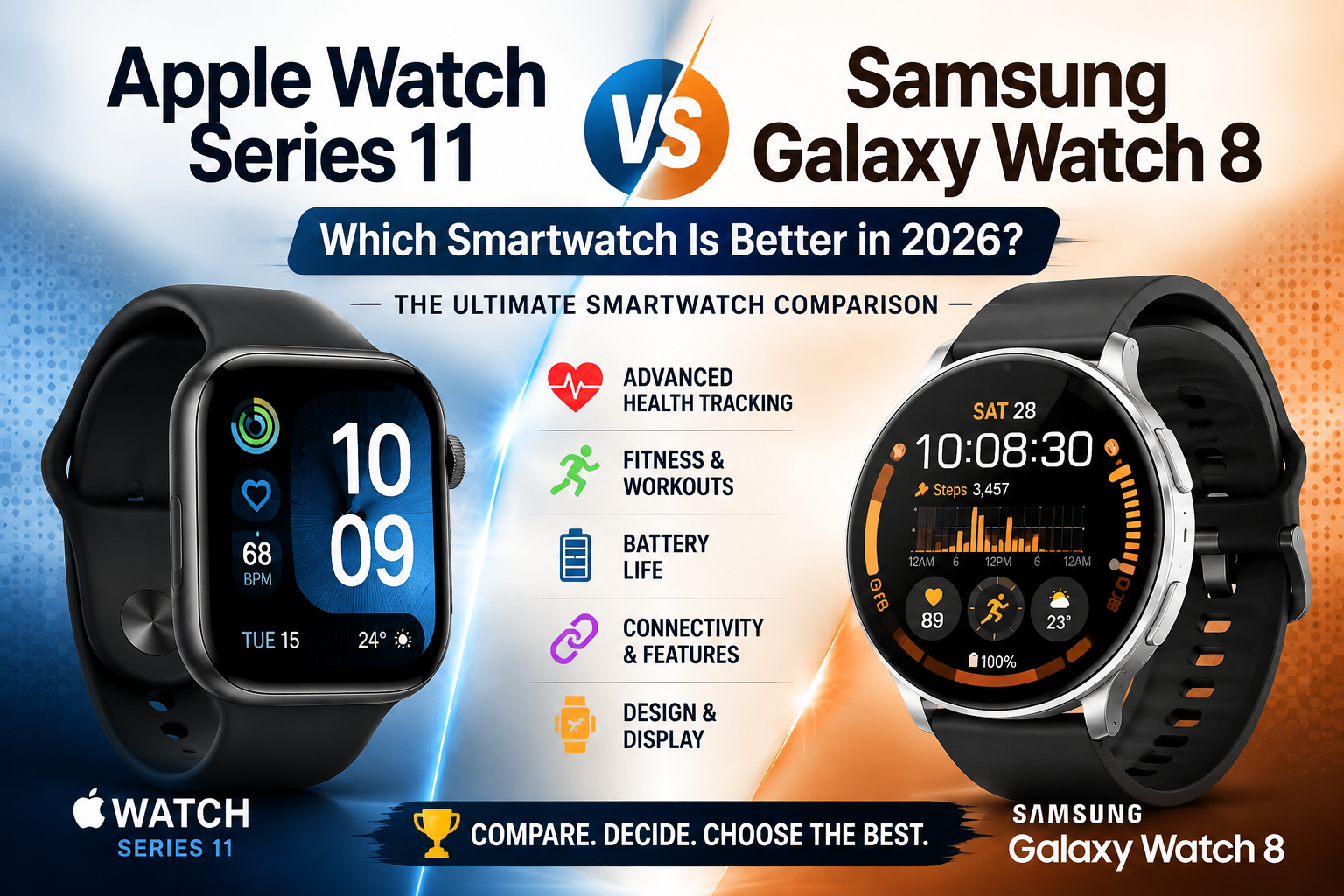
Smart rings are becoming an alternative wearable category, but premium smartwatches like Apple Watch Series 11 and Galaxy Watch 8 still offer advanced health features.
Table of Contents
The future of Smart Rings in 2026 is closely connected with AI-based health analysis, making wearable technology more personalized and intelligent.
Smart Rings in 2026 represent the next step in wearable technology, combining advanced sensors, artificial intelligence, and personalized health insights into a compact form factor. As consumers look for smaller and smarter alternatives to traditional wearables, AI-powered smart rings are becoming an important category in the future of digital health.
What Is a Smart Ring?
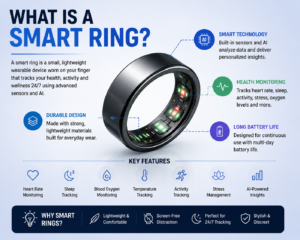
A smart ring is a compact electronic wearable designed to be worn on the finger. From the outside, it can look similar to a traditional ring, but inside it contains miniature sensors and electronic components designed to collect health, fitness, and wellness information.
Depending on the model, a smart ring may track:
- Heart rate
- Heart-rate variability (HRV)
- Blood oxygen trends
- Skin temperature
- Sleep duration
- Sleep stages
- Respiratory patterns
- Physical activity
- Steps
- Movement
- Workout information
- Recovery indicators
- Wellness trends
The collected information is generally transferred to a smartphone application, where users can view measurements, scores, charts, trends, and recommendations.
The real advancement comes when sensor data is combined with artificial intelligence. Instead of requiring users to understand dozens of individual measurements, AI can analyze multiple signals together and identify meaningful patterns.
This makes AI-powered smart rings more than simple fitness trackers. They are becoming intelligent wellness companions designed to help users understand their personal health trends.
The biggest improvements in Smart Rings in 2026 include AI-powered health analysis, improved biometric sensors, better battery performance, and more personalized user experiences.
Why Smart Rings Are Trending in 2026
The growing popularity of smart rings is connected to a broader change in consumer behavior.
People increasingly want useful technology without constant digital distractions.
Smartwatches are highly capable devices. They can provide notifications, calls, applications, GPS, workouts, music controls, and health tracking. However, their displays can also encourage users to interact with technology throughout the day.
Smart rings offer a different approach.
They are generally:
- Small and lightweight
- Screen-free
- Discreet
- Comfortable for continuous wear
- Convenient for sleep tracking
- Less distracting
- Similar to traditional jewelry
This makes them attractive to consumers who want health monitoring without constantly looking at a display.
Smart rings are therefore unlikely to completely replace smartwatches. Instead, the two categories can complement each other.
A smartwatch can provide interactive features, while a smart ring can focus on passive health, sleep, and wellness monitoring.
How AI Is Transforming Smart Rings
The biggest technological development in this category is the integration of artificial intelligence.
Sensors are responsible for collecting information, but collecting information is only the first step.
For example, a wearable may record a resting heart rate of 72 BPM. By itself, that number provides limited context.
An intelligent system can compare that measurement with previous readings, sleep quality, activity levels, recovery information, and other available signals.
The system may identify that the user’s resting heart rate has been consistently higher than their personal baseline.
That type of interpretation can be more useful than simply displaying a number.
AI can potentially support:
- Pattern recognition
- Personalized insights
- Sleep analysis
- Recovery analysis
- Activity interpretation
- Long-term trend identification
- Health-data summaries
- Personalized recommendations
This represents an important shift from data collection to data interpretation.
Instead of asking users to understand complex health metrics themselves, AI can present information in a simpler and more personalized format.
That is one of the main reasons AI-powered smart rings are attracting attention in the wearable technology market.
Personalized Health Insights
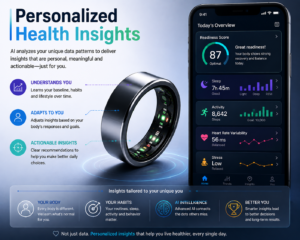
One of the biggest advantages of intelligent wearable technology is personalization.
Every person’s body, lifestyle, sleep schedule, exercise habits, and daily routine are different. A sleep duration that works well for one person may not have the same effect on another.
AI systems can analyze an individual’s historical data and establish personal patterns.
Instead of comparing every user with a generic target, an intelligent health platform can compare current measurements with the person’s own recent baseline.
This can make health information more relevant.
Over time, the system may identify relationships between:
- Sleep and exercise
- Activity and recovery
- Resting heart rate and sleep
- HRV and recovery
- Bedtime consistency
- Daily movement
- Temperature trends
For example, a user might discover that irregular sleep is consistently followed by lower recovery scores. Another user might notice that intense workouts affect their sleep quality.
These observations can help people understand their routines and make more informed lifestyle decisions.
The value comes not necessarily from one day’s measurement, but from identifying patterns across weeks and months.
Smart Rings and Sleep Tracking
Sleep tracking is one of the strongest use cases for smart rings.
Many people find wearing a smartwatch while sleeping uncomfortable. A ring is generally smaller, lighter, and does not require interaction with a screen.
Depending on the model, a smart ring may monitor:
- Total sleep duration
- Sleep timing
- Sleep stages
- Nighttime heart rate
- HRV
- Movement
- Respiratory information
- Skin-temperature changes
- Blood oxygen trends
Products such as Oura Ring 4 and Samsung Galaxy Ring have helped bring sleep-focused wearable technology into the mainstream.
The most valuable information may not be a single night’s sleep score. Long-term trends can provide a much broader picture.
For example, users may discover that:
- Their sleep decreases when their schedule becomes irregular.
- Recovery changes after intense exercise.
- Resting heart rate changes after poor sleep.
- Consistent bedtimes are associated with better wellness trends.
AI can make this information easier to understand by connecting different measurements instead of treating each metric separately.
This is an important area where AI-powered smart rings can potentially provide more value than traditional activity trackers.
AI-Powered Recovery and Readiness
Wearable technology is gradually moving beyond the simple question:
“How much did you exercise?”
Modern wellness platforms are increasingly interested in another question:
“How well are you recovering?”
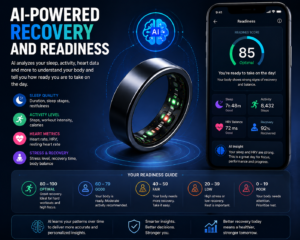
Recovery systems can combine sleep information, heart-related measurements, activity levels, and other available signals to estimate how prepared someone may be for another demanding day or workout.
For fitness enthusiasts, this can be particularly useful.
Imagine completing an intense workout but sleeping poorly afterward. An intelligent platform may identify that your recovery indicators are lower than your usual baseline.
This does not mean the device knows exactly what is happening inside the body. Instead, it provides data-based context that users can consider when planning exercise and daily activities.
For runners, gym users, athletes, and wellness-focused consumers, this type of analysis can make wearable data more practical.
Heart Health Monitoring
Heart-related measurements are another important part of modern smart-ring technology.
Depending on the device, a smart ring can monitor heart rate continuously or periodically and calculate metrics such as heart-rate variability.
These measurements can help users identify trends rather than focusing on isolated readings.
Users may notice changes in:
- Resting heart rate
- HRV
- Activity-related heart rate
- Nighttime heart rate
- Recovery patterns
However, an important limitation must be clearly understood.
A smart ring is not automatically a medical diagnostic device.
Consumer wearables can be useful for wellness monitoring, but they should not replace professional medical evaluation.
If a person experiences concerning symptoms, they should seek appropriate medical advice rather than relying on a wearable device.
The purpose of a consumer smart ring is generally to provide personal wellness information and help users understand trends.
Blood Oxygen and Respiratory Monitoring
Some advanced smart rings can monitor blood oxygen-related trends, particularly during sleep.
Optical sensors collect relevant signals, which can then be processed alongside other measurements.
The real value is often found in observing patterns over multiple nights rather than becoming concerned about a single reading.
AI-based analysis can potentially identify changes across multiple measurements and present those trends in a more understandable format.
However, consumer wearable measurements can differ from readings obtained through clinical medical equipment.
Users should therefore understand the capabilities and limitations of their specific device and avoid treating wellness measurements as medical diagnoses.
AI Health Coaching Is the Next Step
Wearable technology is gradually moving from tracking toward coaching.
A basic tracker might simply tell you:
You slept for 6 hours and 30 minutes.
A more intelligent platform could provide additional context:
Your sleep duration was below your recent average, and your recovery indicators also changed.
This type of personalized feedback represents an important direction for wearable technology.
Future AI health coaching systems may help users:
- Build healthier routines
- Improve sleep consistency
- Manage exercise intensity
- Understand recovery
- Recognize behavioral patterns
- Create realistic goals
- Maintain motivation
However, effective AI coaching should focus on useful context rather than exaggerated medical claims.
The goal should be to help people understand their information, not convince them that an algorithm can replace healthcare professionals.
Smart Rings for Every Generation
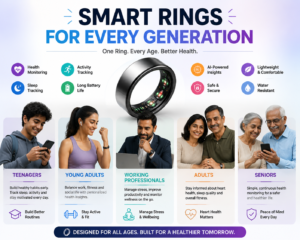
Smart rings are not limited to professional athletes or technology enthusiasts.
Their small size, discreet design, and passive tracking capabilities can make them attractive to different types of users.
Young Adults and Students
Students and younger users may use smart rings to monitor:
- Sleep schedules
- Physical activity
- Exercise
- Recovery
- Daily routines
Students with irregular schedules may find long-term sleep and activity trends useful for understanding their lifestyle.
Working Professionals
Professionals often spend long hours working and may not want another screen competing for their attention.
A smart ring can provide passive monitoring while allowing the user to focus on work.
It may track:
- Sleep
- Activity
- Recovery
- Heart-related trends
- Daily movement
Fitness Enthusiasts
Fitness users can combine a smart ring with a smartwatch.
For example:
Smartwatch: GPS, workouts, real-time exercise information, notifications, and apps.
Smart ring: Sleep, recovery, passive monitoring, and long-term wellness trends.
Together, these devices can provide a broader picture of daily health and fitness.
Older Adults
Older users may appreciate a wearable that does not require constant interaction with a touchscreen.
However, comfort, smartphone compatibility, ease of use, battery life, and the required features should all be considered before purchasing a device.
Smart Ring vs. Smartwatch
Many consumers wonder whether they should purchase a smart ring or a smartwatch.
There is no universal winner. The better option depends on the user’s priorities.
| Feature | Smart Ring | Smartwatch |
|---|---|---|
| Display | Usually no | Yes |
| Notifications | Limited | Extensive |
| Sleep tracking | Strong focus | Available |
| Health tracking | Strong | Strong |
| GPS | Usually phone-dependent | Often available |
| Battery life | Generally multi-day | Usually shorter |
| Apps | Limited | Extensive |
| Calls | Usually unavailable | Available on many models |
| Discreet design | Excellent | Moderate |
| Screen interaction | Minimal | Extensive |
| Recovery tracking | Strong on some models | Available |
| Fitness features | Increasing | Usually stronger |
A smartwatch remains the better choice for users who want an all-in-one connected device.
A smart ring is more suitable for users who prioritize discreet health monitoring, sleep tracking, comfort, and long-term wellness trends.
Oura Ring 4 and Samsung Galaxy Ring
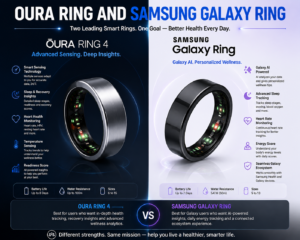
The smart-ring category has become increasingly competitive, with established wearable brands developing products for consumers interested in health and wellness tracking.
Oura Ring 4
Oura is one of the best-known names in the smart-ring market.
Oura Ring 4 focuses heavily on health, sleep, readiness, and recovery. Its sensing technologies are designed to monitor measurements such as heart rate, HRV, blood oxygen, temperature, and movement.
The Oura ecosystem is particularly well known for turning collected information into sleep, readiness, and wellness insights.
Samsung Galaxy Ring
Samsung Galaxy Ring is another major competitor.
It integrates with Samsung Health and connects closely with the broader Galaxy ecosystem.
Samsung highlights features including sleep tracking, heart-rate monitoring, Energy Score, and wellness-related insights.
For consumers who already use Samsung smartphones, watches, or other Galaxy products, ecosystem integration can be an important advantage.
Competition between these brands is encouraging innovation in sensor technology, comfort, battery life, software, and AI-based health insights.
Why Battery Life Matters
Battery life is extremely important for health-focused wearable devices.
A smart ring designed for continuous sleep and wellness tracking becomes less useful if it frequently needs to be removed for charging.
Many current smart rings are designed to operate for several days between charges, although actual battery life depends on the model, size, settings, usage, and other factors.
Longer battery life provides an important advantage:
The longer users can wear the device, the more complete their long-term dataset can become.
Continuous data can improve the usefulness of sleep, activity, and recovery trend analysis.
For anyone buying a smart ring primarily for health tracking, battery life should therefore be considered alongside sensor capabilities and comfort.
Why Screenless Wearables Are Becoming Popular
One of the most interesting trends in wearable technology is the rise of devices that do not have screens.
This may seem unusual in an industry where smartwatch displays continue to become larger and more capable.
However, some consumers are now actively looking for technology that does not constantly demand their attention.
A smart ring can quietly collect information without displaying notifications every few minutes.
This creates the idea of ambient technology.
The device remains present, but it does not constantly demand interaction.
For people trying to reduce screen time while still benefiting from digital health tracking, this approach can be especially attractive.
The popularity of Smart Rings in 2026 comes from the demand for smaller, smarter, and more comfortable wearable devices that can provide continuous health insights.
Smart Rings Are Becoming More Fashionable
Technology is increasingly becoming part of everyday fashion.
Older wearable devices often looked like miniature computers attached to the body. Modern smart rings are increasingly designed to resemble jewelry.
This matters because a device intended for continuous or near-continuous use needs to be both comfortable and visually acceptable.
People may wear smart rings:
- At work
- At home
- During exercise
- While sleeping
- During travel
- At social events
The combination of technology and jewelry-inspired design could help smart rings reach consumers who previously avoided traditional fitness trackers.
Privacy: The Biggest Question for AI Wearables
The growing adoption of AI-powered smart rings also creates an important privacy conversation.
Health and wellness data can reveal highly personal information about a person’s lifestyle and daily habits.
A smart ring may collect information related to:
- Sleep patterns
- Activity
- Heart-related measurements
- Temperature
- Exercise
- Daily routines
- Recovery
Before purchasing a smart ring, consumers should understand:
- What information is collected
- Where the data is stored
- Whether information is shared with third parties
- How long data is retained
- Whether data can be deleted
- How AI systems process the information
- Whether cloud processing is required
Privacy should be considered alongside sensor accuracy, comfort, battery life, and design.
A technologically impressive wearable may not be the right choice if its data practices do not match the user’s expectations.
Limitations You Should Know Before Buying
Smart rings offer many advantages, but they are not perfect.
Accuracy Can Vary
Sensor performance can be influenced by movement, fit, skin contact, device design, and other factors.
Correct Sizing Is Important
A poorly fitted ring can become uncomfortable and may also affect sensor contact.
Limited Smart Features
Most smart rings cannot compete with smartwatches when it comes to apps, notifications, GPS, communication, and real-time interaction.
The biggest advantage of Smart Rings in 2026 is their ability to provide continuous health insights without the bulk of traditional wearable devices.
Subscription Costs
Some companies place advanced insights and features behind subscriptions. Buyers should consider both the initial price and long-term ownership cost.
AI Is Not Infallible
AI-generated insights depend on the quality of the collected data and the algorithms being used. They can provide useful context but should not automatically be interpreted as medical conclusions.
Smartphone Compatibility
Some smart rings work better within specific smartphone ecosystems. Compatibility should always be checked before purchase.
How to Choose a Smart Ring in 2026
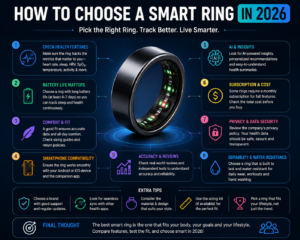
Choosing the right smart ring requires more than looking at the design or the word “AI.”
Consider these important factors.
1. Health Sensors
Check exactly which measurements the device supports.
Do not assume every smart ring offers the same health features.
2. Battery Life
Long battery life is valuable for people who want continuous sleep and wellness tracking.
3. Comfort
Because a smart ring may be worn throughout the day and night, comfort should be a major consideration.
4. Smartphone Compatibility
Make sure the ring works properly with your smartphone and preferred ecosystem.
5. AI Features
Do not buy a device simply because it advertises AI.
Look at what the AI actually provides. Useful trend analysis and personalized insights are more important than marketing terminology.
6. Subscription
Calculate the total cost of ownership, including any recurring subscription or membership fees.
7. Privacy
Review the manufacturer’s privacy policies and understand how your data is collected, processed, stored, and shared.
8. Health Claims
Be cautious about exaggerated health claims. Understand whether a feature is designed for general wellness or has specific medical authorization.
The Future of AI-Powered Smart Rings
The next generation of smart rings could become significantly more advanced.
Future products may offer:
- More accurate sensors
- Smaller components
- Longer battery life
- Better temperature sensing
- Improved sleep analysis
- More sophisticated AI
- Personalized wellness recommendations
- Better recovery predictions
- Stronger smartphone integration
- Deeper smartwatch integration
- More advanced wellness analytics
The most important development may be the ability to combine information from multiple devices.
Imagine a future ecosystem where:
Smart ring + smartwatch + smartphone + AI
work together.
The smart ring could collect continuous physiological information.
The smartwatch could provide workout, GPS, and activity information.
The smartphone could act as the primary interface.
AI could combine these data streams and create a more complete picture of the user’s lifestyle.
This could transform wearable technology from a collection of separate devices into a connected personal wellness ecosystem.
Will Smart Rings Replace Smartwatches?
Probably not in the near future.
Instead, both categories are likely to coexist.
Smartwatches are excellent for interactive tasks, while smart rings are particularly useful for discreet tracking.
A smartwatch can provide:
- Messages
- Calls
- Maps
- Notifications
- Apps
- Workout information
A smart ring can focus on:
- Sleep
- Recovery
- Long-term wellness
- Passive health monitoring
- Continuous data collection
For some consumers, owning both devices could eventually become completely normal.
The ring handles passive tracking, while the smartwatch provides the interactive experience.
| Feature | Smart Ring | Smartwatch |
|---|
| Size | Compact | Larger display |
| Battery Life | Longer | Usually shorter |
| Health Tracking | Continuous | Advanced |
| Notifications | Limited | Better |
| Comfort | Excellent | Good |
Are Smart Rings Worth Buying in 2026?
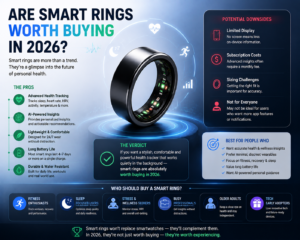
A smart ring can be worth considering if your priorities include:
- Sleep tracking
- Recovery monitoring
- Wellness insights
- Discreet design
- Long battery life
- Minimal screen interaction
- Long-term health trends
However, a smart ring may not be the best option if your main requirements are:
- GPS
- Calls
- Notifications
- Large displays
- Apps
- Advanced real-time workout features
The best wearable is therefore not necessarily the product with the largest number of features.
It is the device that fits your lifestyle and provides the information you actually need.
For consumers who prioritize discreet, continuous wellness monitoring, AI-powered smart rings could be one of the most interesting wearable technologies to consider in 2026.
Before choosing a smart wearable, users should understand how Smart Rings in 2026 compare with smartwatches and fitness trackers. The smaller design, continuous health monitoring, and AI-based insights make smart rings an interesting option for future wearable users.
As technology improves, Smart Rings in 2026 could become an important alternative to traditional wearable devices by offering accurate health insights in a smaller form factor.
As AI technology improves, Smart Rings in 2026 could become an important part of personal health management and future wearable ecosystems.
Final Verdict
Smart rings are entering an exciting stage in 2026.
The category is moving beyond basic step counting and simple fitness measurements toward continuous monitoring, personalization, and AI-assisted interpretation.
The biggest opportunity for AI-powered smart rings is their ability to transform large amounts of sensor data into understandable insights about sleep, activity, recovery, and personal wellness patterns.
Future products are likely to focus on better sensors, longer battery life, improved comfort, stronger software, and more sophisticated AI capabilities.
However, consumers should remain realistic.
Smart rings are not replacements for doctors, medical examinations, or professional healthcare. Their greatest value is helping people understand personal wellness trends and make more informed everyday decisions.
The most important development may therefore not be another sensor.
It may be the ability of AI to answer a much more useful question:
“What does all this data actually mean for me?”
That question could define the next generation of wearable technology.
The wearable of the future may not need a huge screen or hundreds of applications. It may simply need to be small enough to forget about, intelligent enough to identify meaningful patterns, and useful enough to help people make better everyday decisions.
Frequently Asked Questions
What are AI-powered smart rings?
AI-powered smart rings combine miniature sensors with software and artificial intelligence to collect and analyze health, fitness, and wellness-related information. They are designed to turn raw measurements into easier-to-understand trends and insights.
What can a smart ring track?
Depending on the model, a smart ring can track heart rate, HRV, sleep, movement, skin temperature, blood oxygen trends, activity, recovery, and other wellness measurements.
Are smart rings better than smartwatches?
Neither device is universally better. Smart rings are particularly useful for discreet health, sleep, and wellness tracking, while smartwatches offer more interactive features, apps, GPS, notifications, and communication capabilities.
Can smart rings monitor sleep?
Yes. Sleep tracking is one of the major features of many modern smart rings. Depending on the device, they can monitor sleep duration, sleep stages, movement, nighttime heart rate, and other sleep-related signals.
Can AI-powered smart rings diagnose diseases?
Consumers should not assume that they can. Most smart rings are primarily wellness devices. Medical diagnosis should be performed by qualified healthcare professionals using appropriate clinical methods.
How long does a smart ring battery last?
Battery life varies by model and usage. Many modern smart rings are designed to operate for multiple days between charges, although features, settings, ring size, and usage can affect actual battery life.
Do smart rings require a subscription?
It depends on the brand and model. Some provide many features without a recurring subscription, while others may place advanced insights or services behind a membership. Always check the manufacturer’s current pricing and feature structure.
Are smart rings suitable for older adults?
They can be useful for older adults interested in passive wellness tracking, provided the ring is comfortable, compatible with their smartphone, and easy to use.
What is the future of smart rings?
The future is likely to include better sensors, longer battery life, improved AI analysis, more personalized insights, stronger smartphone integration, and deeper connections between smart rings, smartwatches, and other connected devices.
Are smart rings worth buying in 2026?
For users who prioritize sleep tracking, recovery, discreet design, and long-term wellness trends, a smart ring can be a compelling wearable. However, users who need GPS, calls, notifications, apps, and advanced real-time workouts may find a smartwatch more suitable.

3 thoughts on “Smart Rings in 2026: How AI-Powered Health Rings Are Transforming Wearable Technology”